Plastic Gears
Plastic Gears
MD-Lab develops modelling, simulation and testing workflows for polymer gear transmissions, connecting material characterization, finite-element analysis, neural-network surrogates, dynamic/NVH simulation and additive manufacturing.
- 0.49%MAPE for neural-network prediction of polymer-gear STE curves
- Up to 75%lower dynamic factors than comparable metallic gearsets in selected conditions
- Q11-Q12typical ISO quality range measured for FDM-printed polymer gears

Impact
Advances in high-performance polymers are expanding the use of plastic gears beyond traditional low-power applications. Recent studies have demonstrated PEEK gears operating in L7e-class electric-vehicle gearboxes with power levels up to 15 kW and target service lives of 60,000 km, while reinforced polymer gears have transmitted up to 30 kW in experimental test rigs.
- Design confidence: reliable simulation tools are needed to predict the coupled mechanical, thermal and dynamic behavior of polymer gear systems.
- Electrified drivetrains: lightweight, quiet and low-friction polymer gears are increasingly relevant for compact electric powertrains and auxiliary drives.
- Manufacturing realism: dimensional accuracy, surface finish, shrinkage and load capacity must be understood before printed or molded plastic gears can be used reliably in functional transmissions.
MD-Lab’s Research
MD-Lab’s research on plastic gears combines modelling and testing across four connected directions.
- Material modelling: constitutive models, FEA workflows and surrogate-assisted loaded tooth contact analysis.
- NVH performance: dynamic response, mesh stiffness, vibration and acoustic behavior of polymer gear pairs.
- Additive manufacturing: dimensional accuracy, surface quality and load capacity of functional polymer gears.
- Experimental testing: static, dynamic and operational evaluation using dedicated rigs and an FZG-type closed-loop test rig.
Material Modelling
The analysis of plastic gears requires material models capable of capturing high compliance, large deformations, temperature sensitivity and rate-dependent behavior. MD-Lab develops automated finite-element workflows and calibration tools to represent polymer behavior in loaded tooth contact and gear-pair simulations.
For loaded tooth contact analysis, neural-network surrogate models are trained on finite-element simulations of polymeric gears. The workflow combines automated geometry generation, meshing and Abaqus simulations to calculate stresses, force distribution and static transmission error across the meshing cycle.
- 0.49% MAPE on unseen finite-element STE datasets
- Root/contact stress and force distribution prediction
- Several orders of magnitude faster than direct FEA
In parallel, MD-Lab develops material-parameter identification workflows. Experimental measurements drive CAE simulations, response-curve extraction and Bayesian optimization of polymer constitutive parameters, including linear elasticity, Voce plasticity and Perzyna rate-dependent modelling.
Ongoing Research
- Thermal modelling: develop reduced-order and finite-element models to predict temperature rise in plastic gears during operation.
- Model calibration: develop static and operational test rigs that provide data for more reliable polymer material models.
- Viscoplastic effects: study how time-, rate- and load-dependent plastic behavior affects tooth contact, transmission error and durability.
Publications
- Papalexis, C., Sakaridis, E., Terpos, K., Kalligeros, C., Tsolakis, A., & Spitas, V. (2025). Neural network surrogates for finite element models in loaded tooth contact analysis of polymeric gears. Mechanism and Machine Theory, 214, 106127. DOI


NVH Performance
MD-Lab investigates the dynamic behavior of plastic gear pairs using a surrogate-assisted dynamic modelling framework. Neural-network predictions of static transmission error are transformed into time-varying mesh stiffness and integrated into lumped-parameter dynamic models, enabling efficient evaluation of dynamic transmission error, gear-body acceleration, and dynamic load amplification across broad operating conditions.
Research activities focus on polymer materials such as PA66, POM, and PEEK, and compare their performance with equivalent metallic gearsets. Simulations show that plastic gears may exhibit higher static and dynamic transmission-error amplitudes because of their lower stiffness; however, they also produce lower vibration levels and reduced dynamic load amplification.
- Dynamic transmission error prediction
- Gear-body acceleration assessment
- Up to 75% lower dynamic factors than comparable metallic gearsets
Ongoing Research
- Higher-order material effects: incorporate more advanced polymer behavior into dynamic models and assess the implications for NVH response.
- Dynamic testing: measure the dynamic performance of plastic gears under operating conditions.
- Acoustic assessment: connect vibration response with sound radiation and perceived gear noise.
Publications
- Papalexis, C., Sakaridis, E., Terpos, K., Kalligeros, C., Tsolakis, A., & Spitas, V. (2025). Neural network surrogates for finite element models in loaded tooth contact analysis of polymeric gears. Mechanism and Machine Theory, 214, 106127. DOI

Additive Manufacturing
Additive manufacturing is becoming an increasingly important approach for plastic gear research, enabling rapid prototyping, low-volume customization, complex tooth geometries, non-involute and asymmetric gear designs, topology optimization, and lightweight lattice structures.
For polymer gears, these opportunities must be balanced against challenges related to surface finish, dimensional accuracy, shrinkage and load capacity compared with conventional manufacturing methods.
- FDM-printed polymer gears typically around ISO Q11-Q12
- MEX and PBF gears measured around Q12 or higher
- Accuracy remains below high-precision metallic gear standards
MD-Lab investigates the metrology and functional accuracy of polymer spur gears produced through different additive-manufacturing routes, connecting dimensional deviations with operational behavior and wear.
Ongoing Research
- Process comparison: compare additive manufacturing methods to determine their effect on gear accuracy, wear and operational performance.
- Static testing: assess stiffness, load capacity and failure limits of printed gears against traditionally manufactured plastic gears.
- Operational testing: evaluate printed gears under running conditions to determine durability, wear mechanisms and practical load capacity.
Publications
- Papalexis, C., Krifos, D., Kalligeros, C., Bris, N., Tzouganakis, P., Kaisarlis, G., Tsolakis, A., Sapidis, N., & Spitas, V. (2026). Dimensional accuracy assessment of polymeric spur gears fabricated by fused deposition modeling. Hyperfine Interactions, 247, 81. DOI
- Spitas, V., Zalimidis, P., Provatidis, C., Papalexis, C., Kalligeros, C., Kaisarlis, G., Vasileiou, G., & Vakouftsis, C. (2024). Comparative analysis of the ISO tolerance class of 3D-printed spur cylindrical gears produced with Material Extrusion (MEX) and Powder Bed Fusion (PBF) techniques. International Journal of Powertrains, 13. DOI
Testing
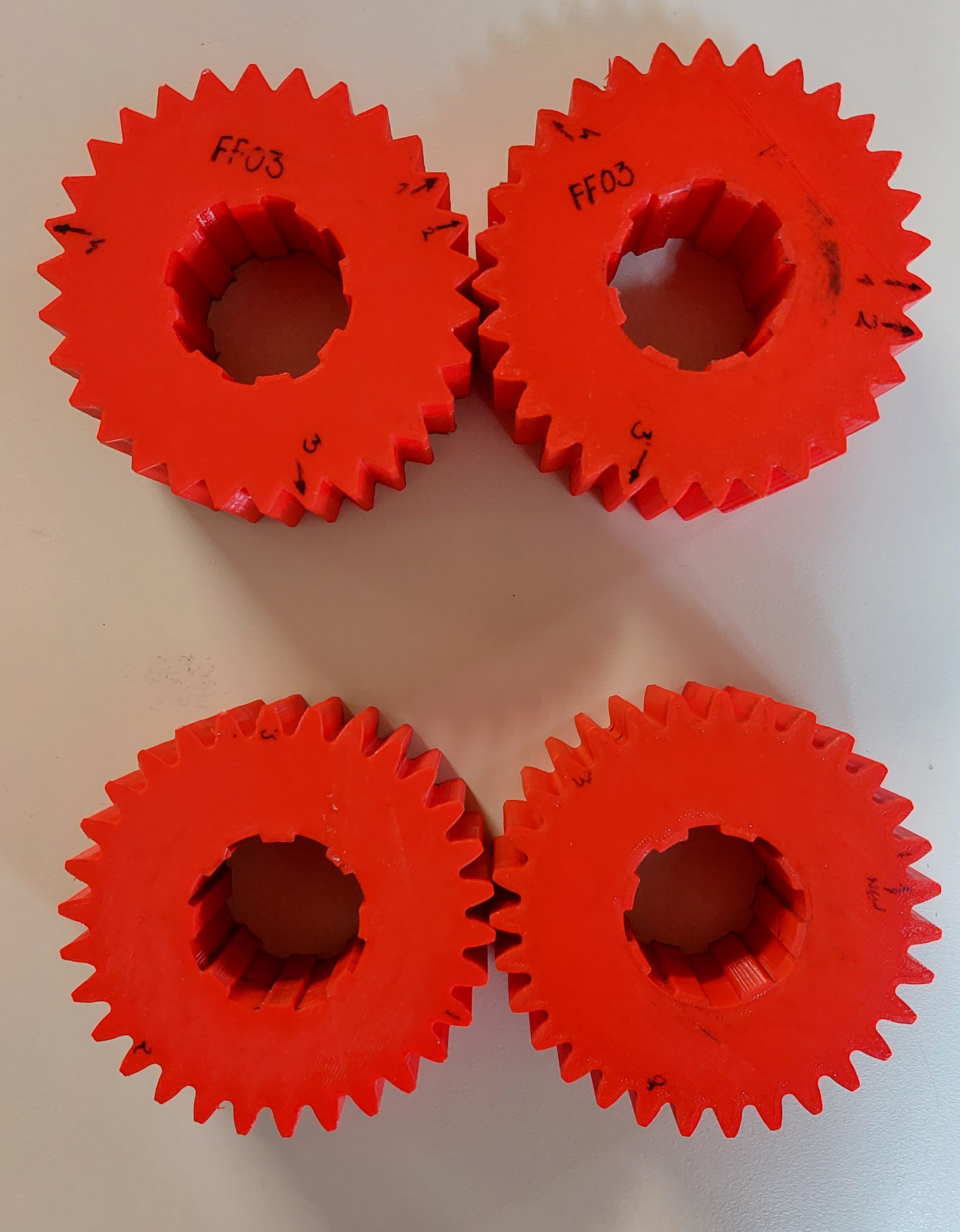
Although dimensional deviations in 3D-printed and injection-molded gears can be substantial, the higher compliance of polymer materials may partially compensate for these inaccuracies during operation.
- Operational validation: plastic gears are evaluated on an FZG-type closed-loop test rig under controlled running conditions.
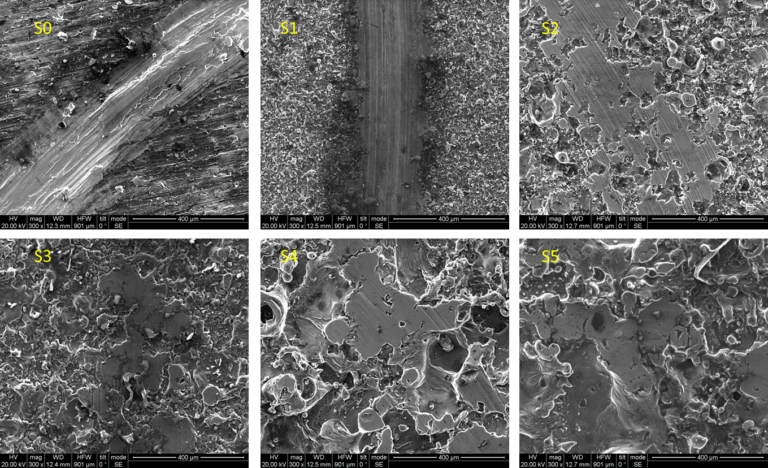
- Wear mechanisms: ongoing studies examine material choice, printing parameters, wear patterns and the feasibility of dry-running polymer gears.
- Model feedback: test data supports calibration of material, thermal and dynamic models used in the simulation workflow.