Gear Optimization
Gear Optimization
MD-Lab develops multi-objective optimization workflows for involute and non-involute gears, connecting surrogate modelling, evolutionary algorithms, geometric constraints and experimental validation to design lighter, quieter and more efficient transmissions.
- 40%+lower power losses in optimized involute gears
- 35%+lower vibration RMS through macro-geometry optimization
- Up to 70%lower maximum wear depth in optimized free-form gears

Impact
Gear optimization has a major industrial impact, as gears are essential components in nearly all power transmission systems, including vehicles, wind turbines, aerospace systems, robotics, and industrial machinery.
- Electric mobility: EV gearboxes require high efficiency and low noise because drivetrain losses and transmission noise directly affect range, performance and comfort. Reducing gearbox losses in a passenger vehicle by only 1 kW can save up to 4 kW of fuel energy equivalent, while gearbox noise must remain below 30-35 dB(A).
- Wind energy: In a modern 5 MW wind turbine, a 50% reduction in gearbox losses can decrease total power losses by approximately 200 kW per turbine. Reliability is equally critical, as around 1,200 gearbox failures occur annually in wind turbines worldwide and repairs can last from several days to two months.
- Industrial scale: Electrification and automated machinery make optimized gearing increasingly important, with the EV market expected to exceed $25 billion by 2030 and the industrial gearbox market projected to approach $40 billion.
MD-Lab’s Research
Our research follows two complementary paths, both aimed at practical performance gains rather than single-metric improvements.
- Involute macro-geometry optimization: established gear profiles are optimized for efficiency, weight and NVH performance.
- Non-involute free-form optimization: the tooth flank itself becomes a design variable for wear, pitting and efficiency improvements.
Involute Gears
We investigate multi-objective macro-geometry optimization of gear transmissions to simultaneously improve weight, efficiency, and NVH (Noise, Vibration, and Harshness) performance. Design variables include:
- Number of teeth
- Module
- Face width
- Profile shift coefficients
- Pressure angle
- Secondary geometric parameters such as addendum and dedendum coefficients, backlash, and rack tip radius
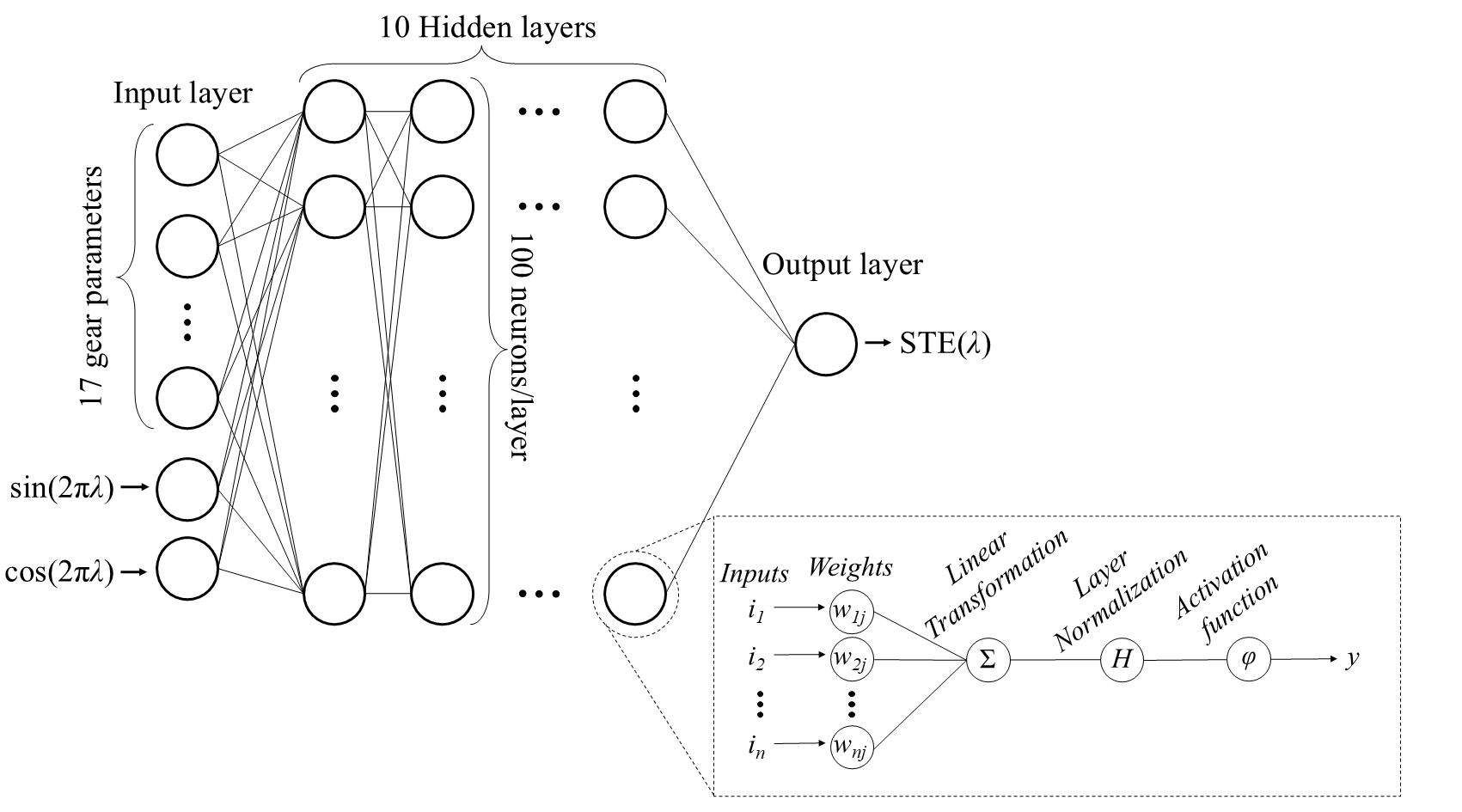
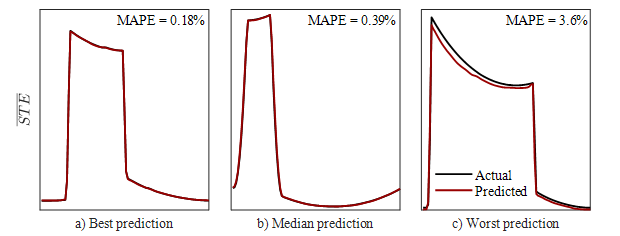
Static Transmission Error (STE) is used as the main indicator of vibration and noise excitation. To avoid slow repeated numerical evaluations, we developed Feed Forward Neural Network (FFNN) surrogate models that predict STE curves with high accuracy.
Evaluation time was reduced from approximately 3 seconds per design to 0.001 seconds, while the generated design-space dataset maintained a mean absolute percentage error of only 0.395%.
Using evolutionary multi-objective optimization, particularly NSGA-II, the current results include:
- More than 40% reduction in power losses
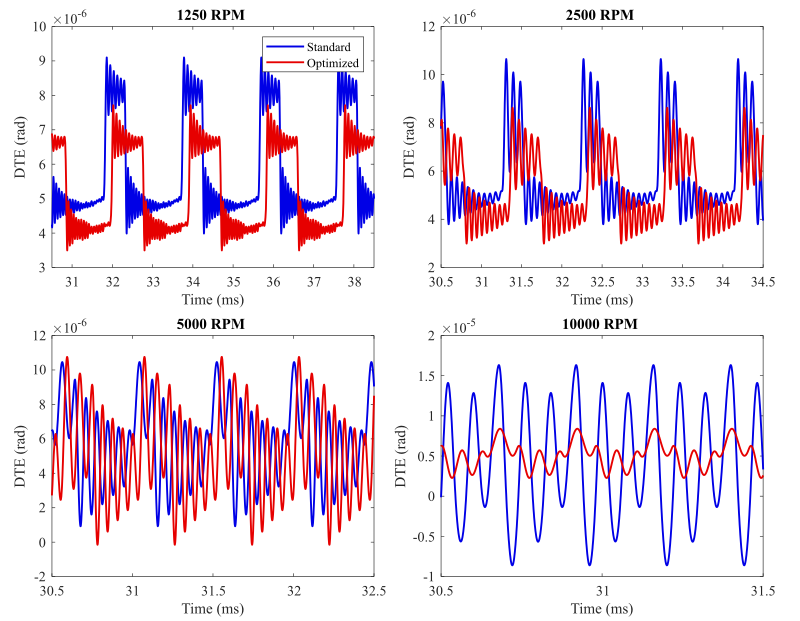
- More than 35% reduction in RMS dynamic transmission error
- More than 70% reduction in vibration amplitude
The optimal trade-off between efficiency, NVH performance, and weight is generally achieved by increasing the number of teeth, reducing the module and face width, and increasing the profile shift coefficients.
Ongoing Research
- Micro-geometry: incorporate tip and root relief to further improve NVH performance.
- Helical gears: extend static transmission error models so optimization can support helical gearbox designs.
- Applications: develop targeted schemes for EV gearboxes, wind turbine gearboxes and gearboxes for human-centered robotics.
- Experimental testing: quantify the effect of optimized gear geometries on measured performance.
Publications
- Kalligeros, C., Papalexis, C., Kostopoulos, G., Terpos, K., Tzouganakis, P., Kostas, K., Halim, D., Yang, J., Spitas, C., Tsolakis, A., Sakaridis, E., & Spitas, V. (2026). A multi-objective macro-geometry spur gear optimization process to improve weight, efficiency and NVH performance utilizing neural networks. Mechanism and Machine Theory, 223, 106422. DOI
- Sakaridis, E., Kalligeros, C., Papalexis, C., Kostopoulos, G., & Spitas, V. (2023). Symmetry preserving neural network models for spur gear static transmission error curves. Mechanism and Machine Theory, 187, 105369. DOI

Non-Involute Gears
Although involute gears dominate modern transmissions, alternative profiles can address limitations such as suboptimal pitting resistance, lubrication behavior and convex-to-convex contact. Most approaches start from predefined profiles, including cycloidal, circular-arc and parabolic geometries.
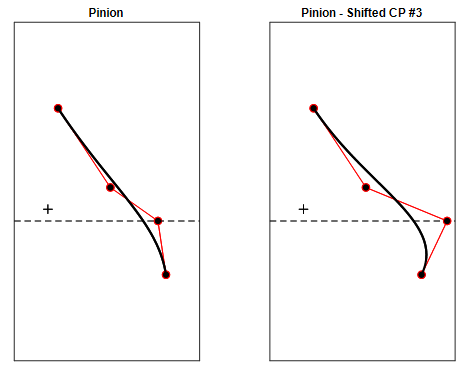
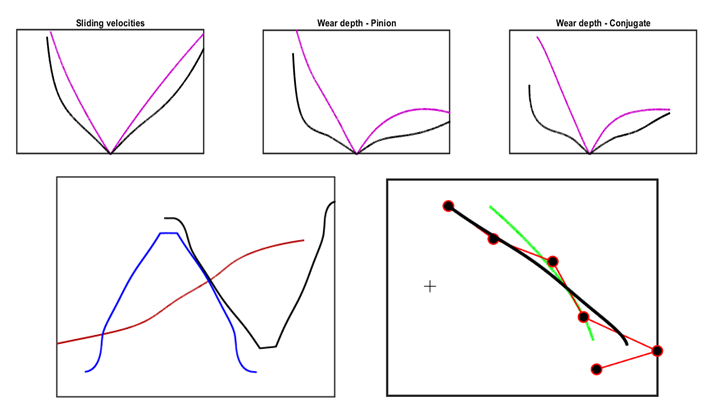
At MD-Lab, the tooth profile itself becomes the design variable. The flank is represented as a parametric curve, such as a B-spline, and its control points are optimized directly for metrics including efficiency and wear resistance.
This free-form optimization methodology has already achieved:
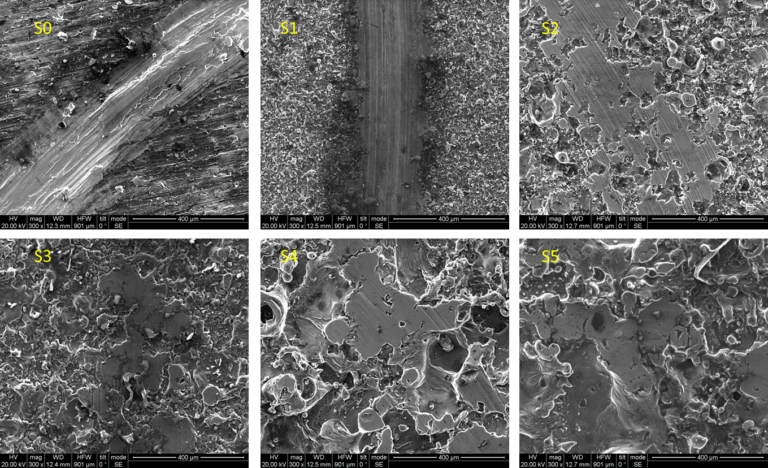
- Up to 55% reduction in average wear depth
- Up to 70% reduction in maximum wear depth
We have also developed new analytical methods and geometric constraints to ensure proper meshing conditions, eliminate geometric discontinuities, and maintain acceptable contact ratios.
Ongoing Research
- Profile comparison: evaluate alternative non-involute profiles to identify the best-performing geometry for each target metric.
- Robust flank design: optimize tooth profiles in the presence of misalignment and center-distance variation.
- Experimental validation: test optimized profiles to confirm the numerical optimization results.
Publications
- Kalligeros, C., Papalexis, C., Georgiou, D., Kryfos, D., Vakouftsis, C., Terpos, K., Goudas, K., Balis, P., Kontaris, T., Kaisarlis, G., Tsolakis, A., Zalimidis, P., Sapidis, N., Provatidis, C., & Spitas, V. (2023). Improving the wear resistance of 3D printed spur gears through a free-form tooth flank optimization process. MATEC Web of Conferences, 387. DOI
- Kalligeros, C., Koronaios, P., Tzouganakis, P., Papalexis, C., Tsolakis, A., & Spitas, V. (2022). Development of a free-form tooth flank optimization method to improve pitting resistance of spur gears. MATEC Web of Conferences, 366, 01003. DOI