Gear Dynamics
Gear Dynamics
MD-Lab research on gear dynamics develops reduced-order, nonlinear and data-driven simulation models for spur gear transmissions. The work connects static and dynamic transmission error, load-dependent mesh stiffness, intermittent contact, tooth eigenvibrations and high-pressure-angle gear design.
- DTE modelreduced-order response prediction using nonlinear mesh stiffness and STE excitation
- SDOFnon-implicit formulation with load- and position-dependent mesh stiffness
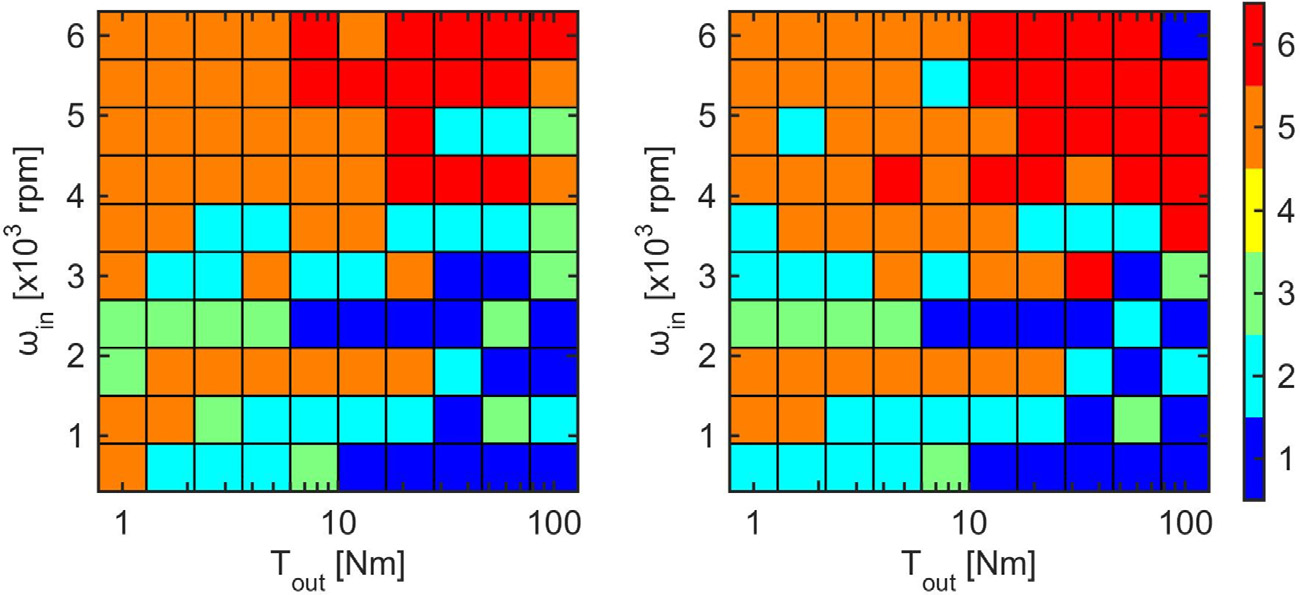
- Tooth modesintermittent contact and eigenvibration effects mapped across speed and load
Impact
Gear transmissions are compact and efficient, but their vibration response is governed by strongly nonlinear phenomena: time-varying mesh stiffness, backlash, contact loss, corner contact, load-dependent tooth compliance and the interaction between static and dynamic transmission error. These effects matter directly for noise, vibration and harshness, especially in electric drivetrains where tonal gear noise is more exposed.
The design problem is difficult because high-fidelity tooth contact analysis and finite-element simulation are too expensive for broad optimization studies, while overly simple dynamic models can miss the nonlinear response that designers need to avoid. MD-Lab’s gear-dynamics work builds reduced-order models that retain the physical mechanisms needed for design, yet remain fast enough for parameter sweeps, optimization and early-stage concept selection.
MD-Lab’s Research
The gear-dynamics research program links modelling depth with design usability.
- Reduced-order modelling: formulate fast gear-pair models that predict dynamic transmission error without full transient FEA.
- Dynamic-response prediction: use static transmission error, load-dependent mesh stiffness and compact equations of motion to estimate DTE trends.
- Data-driven extensions: develop neural-network approaches for direct prediction of gear dynamic response.
- Higher-order modelling: extend the workflow toward helical gears and FEA studies of higher-order gear-dynamics phenomena.
Reduced-Order Dynamic Model
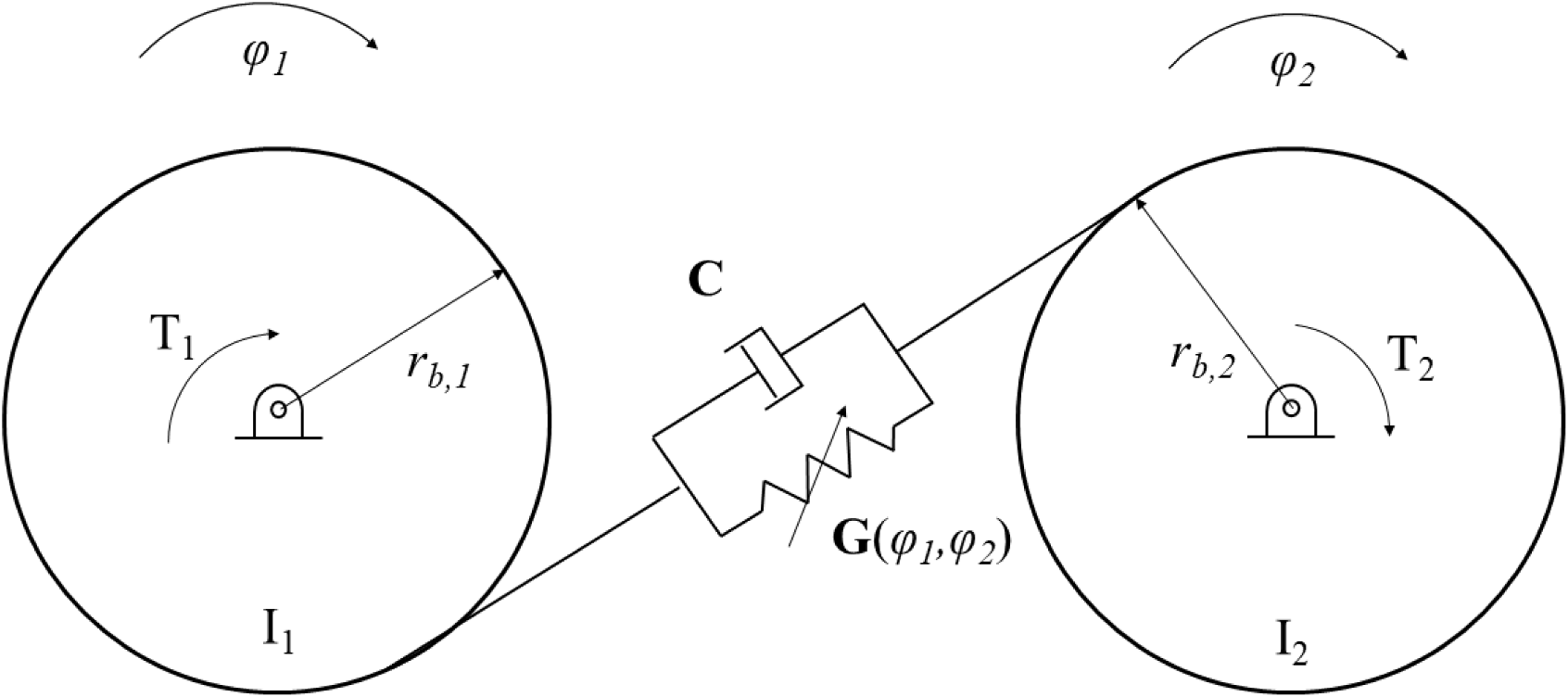
The main modelling approach uses a reduced-order gear-pair dynamic formulation to evaluate dynamic transmission error without the cost of full transient finite-element simulation. The gear pair is represented through the rotational inertias of the pinion and wheel, damping, applied torques and a nonlinear mesh stiffness term that depends on the instantaneous angular position of the gears.
Static transmission error is used as the excitation that feeds the dynamic model. This allows the model to connect gear geometry and load-dependent mesh behavior with the resulting DTE response while remaining fast enough for repeated simulation. The formulation is especially useful for comparing candidate gear designs because it preserves the nonlinear response features that matter for NVH while keeping the computational model compact.
- Reduced-order gear-pair model with pinion and wheel rotational inertias
- Nonlinear position-dependent mesh stiffness used in the dynamic response calculation
- Static transmission error curves used as the excitation input for DTE prediction
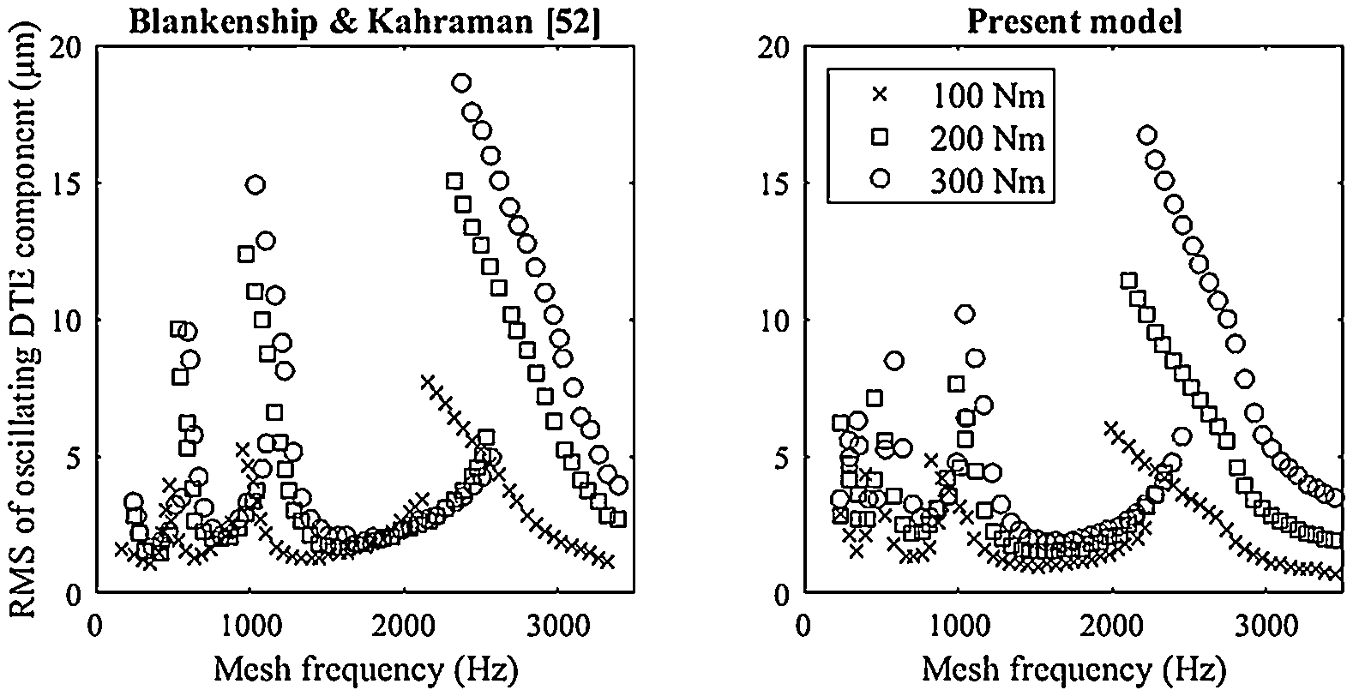
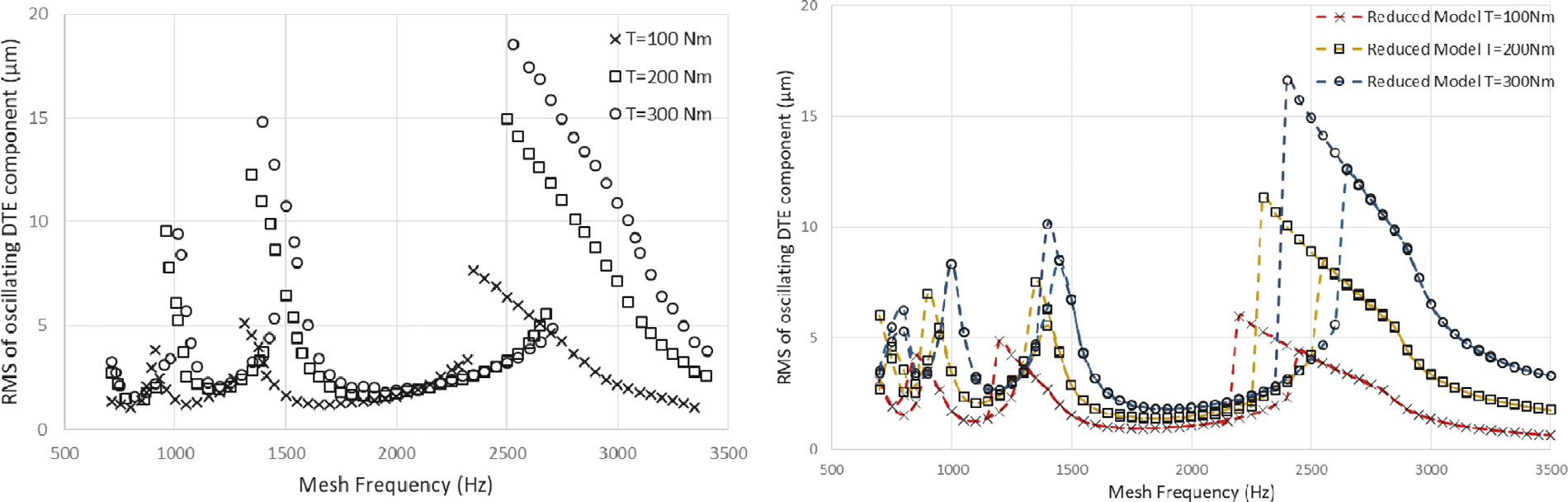
- Jump effects, hysteresis trends and load-dependent natural-frequency shifts captured in validation studies
The model is validated against established experimental gear-dynamics data and reproduces key response trends across mesh frequency and torque levels. This makes it a practical intermediate layer between detailed tooth-contact physics and fast design-stage evaluation.
Ongoing Research
- Implementation of neural networks to predict dynamic response.
- Development of dynamic models for helical gears.
- Development of FEA models to study higher-order phenomena.
Related Publications
- Kalligeros, C., Papalexis, C., Kostopoulos, G., Terpos, K., Tzouganakis, P., Kostas, K., Halim, D., Yang, J., Spitas, C., Tsolakis, A., Sakaridis, E., & Spitas, V. (2026). A multi-objective macro-geometry spur gear optimization process to improve weight, efficiency and NVH performance utilizing neural networks. Mechanism and Machine Theory, 223, 106422. https://doi.org/10.1016/j.mechmachtheory.2026.106422
- Sakaridis, E., Spitas, V., & Spitas, C. (2019). Non-linear modeling of gear drive dynamics incorporating intermittent tooth contact analysis and tooth eigenvibrations. Mechanism and Machine Theory, 136, 307-333. https://doi.org/10.1016/j.mechmachtheory.2019.03.012
Fast Non-Implicit SDOF Gear Dynamics
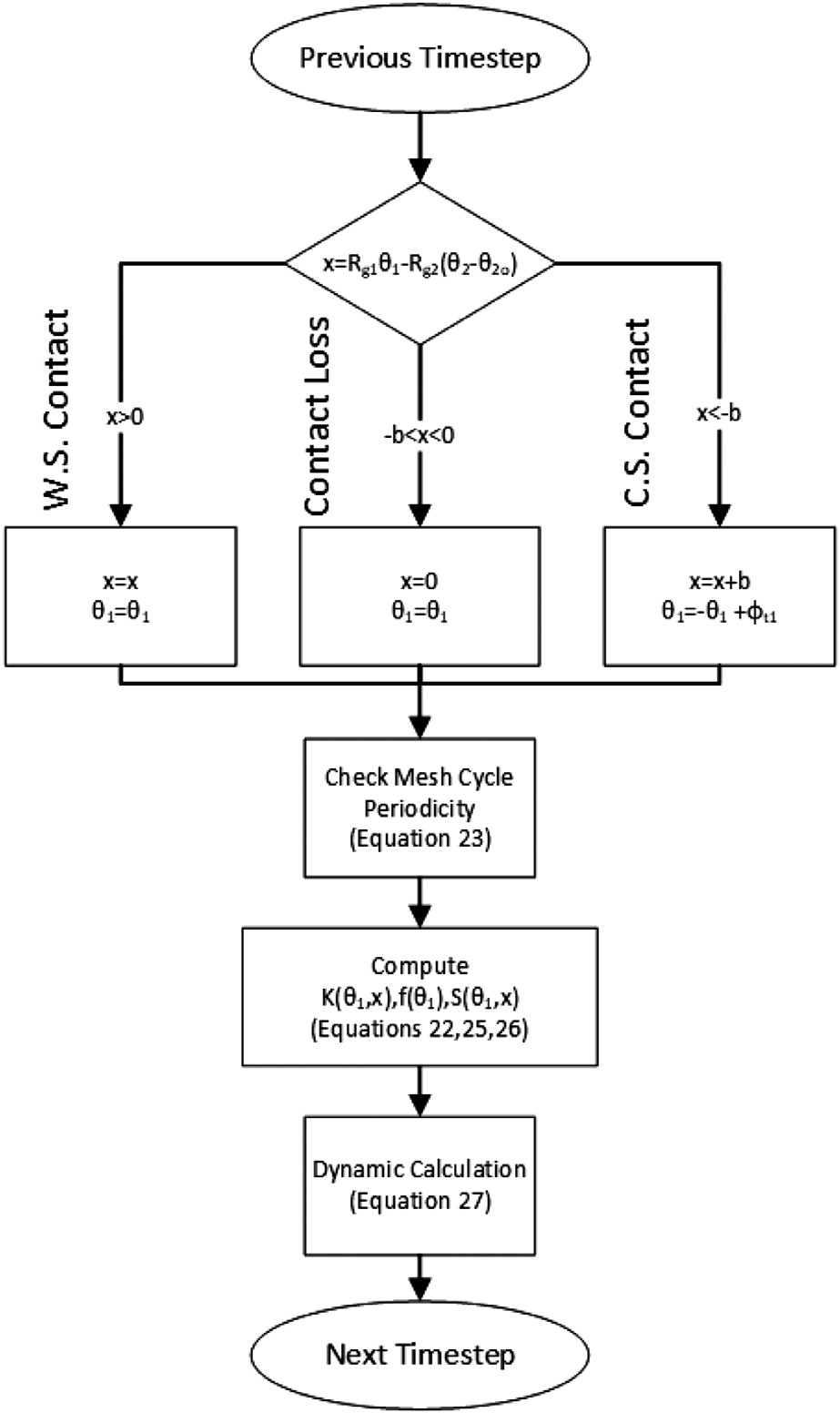
The second modelling direction focuses on a fast single-degree-of-freedom formulation for spur gear dynamics. The challenge is to keep the model simple enough for repeated simulation while still capturing the nonlinear mechanics that dominate real meshing response: backlash, changing contact state, load-dependent mesh stiffness, contact reversal and corner contact.
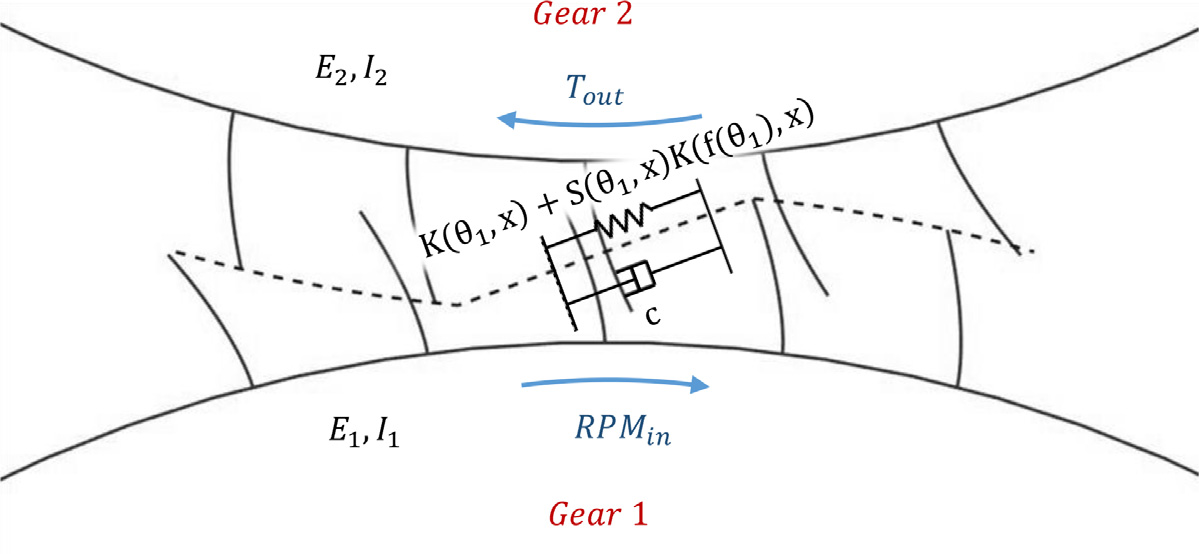
MD-Lab’s non-implicit SDOF model derives mesh stiffness in-line from a closed-form, physics-based expression rather than from large precomputed lookup tables. A geometric contact-reversal method handles coast-side and working-side contact, while a modified parametric s-curve captures the transition between single and double tooth contact, including corner-contact effects.
- Closed-form load- and position-dependent gear-pair mesh stiffness
- Once-per-gearstage fitting with a limited number of parameters
- Prediction of nonlinear jumps, subharmonic resonances and load-dependent frequency shifts
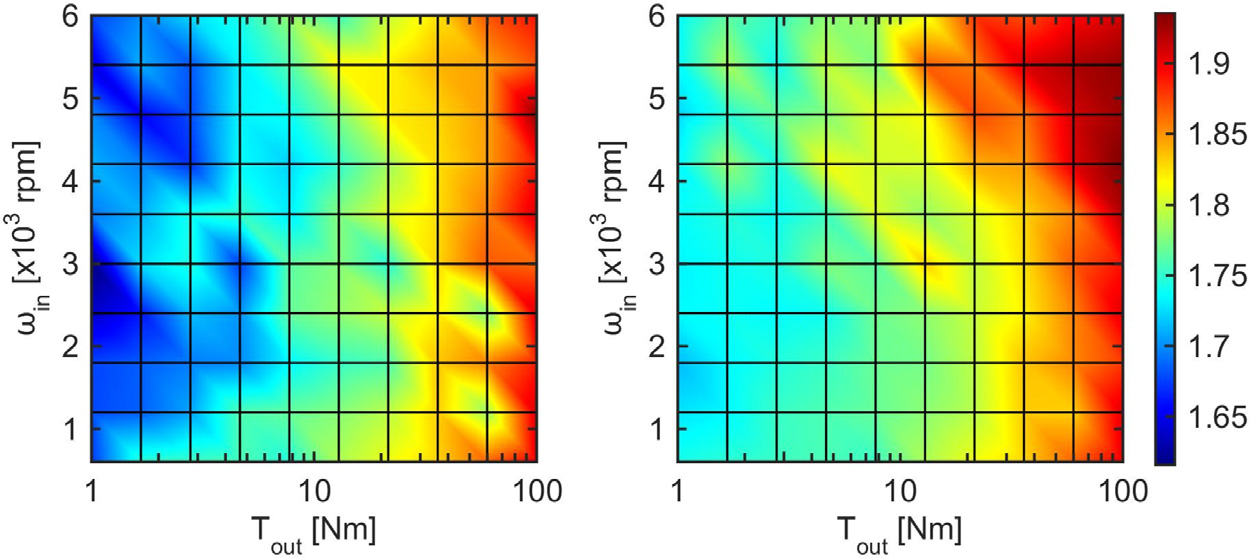
- Extension to 30-35 degree high-pressure-angle spur gears with improved DTE response in many operating regions
The same reduced-order modelling philosophy supports the later high-pressure-angle gear work. By extending the load- and position-dependent stiffness formulation to non-standard geometries, the model can compare standard 20-degree spur gears with high-pressure-angle designs over wide speed and torque maps.
Related Publications
- Gkimisis, L., Vasileiou, G., Sakaridis, E., Spitas, C., & Spitas, V. (2021). A fast, non-implicit SDOF model for spur gear dynamics. Mechanism and Machine Theory, 160, 104279. https://doi.org/10.1016/j.mechmachtheory.2021.104279
- Vasileiou, G., Rogkas, N., Gkimisis, L., & Spitas, V. (2025). Dynamic simulation of high-pressure angle spur gears. Proceedings of the Institution of Mechanical Engineers, Part C: Journal of Mechanical Engineering Science. https://doi.org/10.1177/09544062251352343
Intermittent Contact and Tooth Eigenvibrations
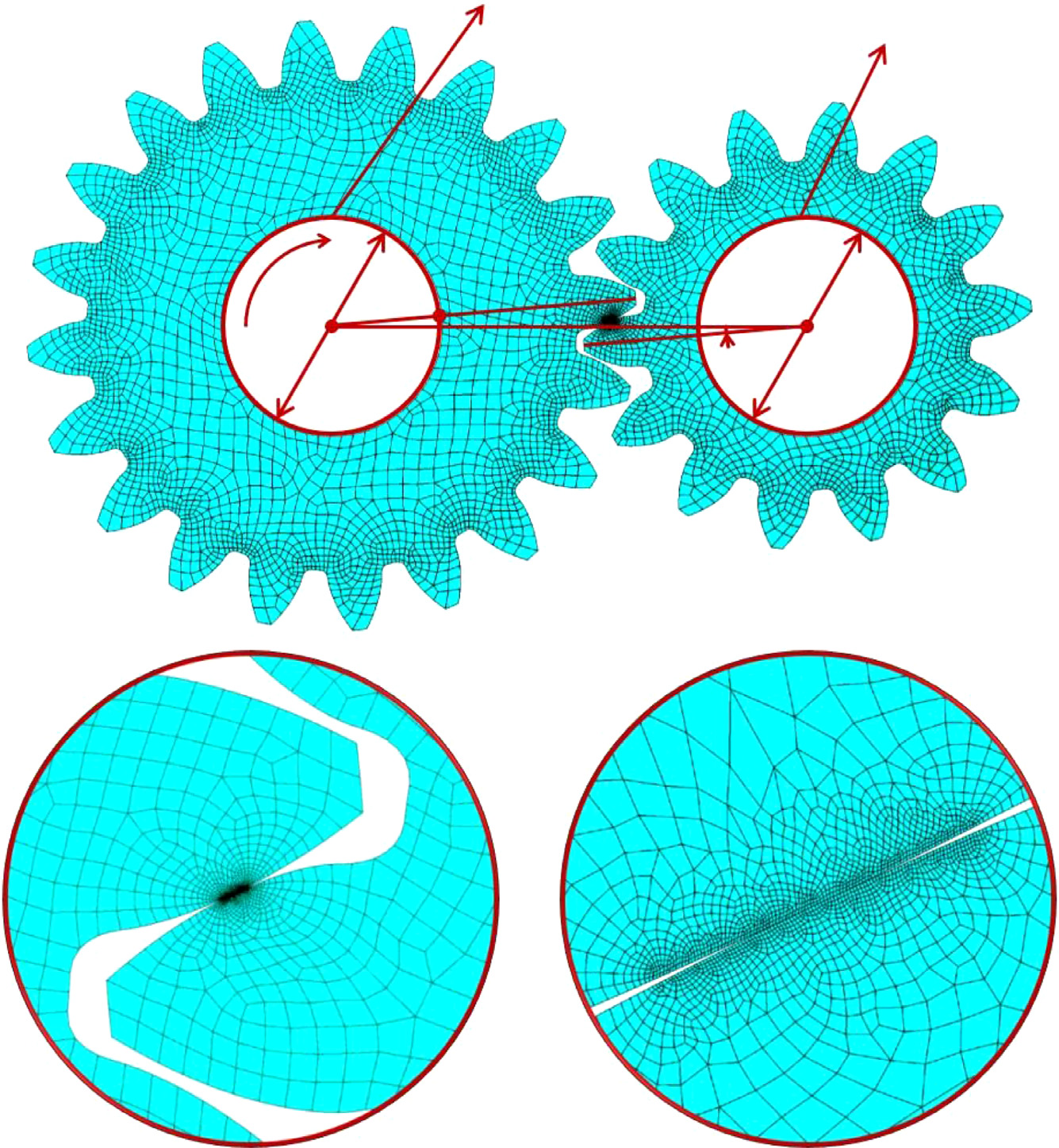
The third research direction examines when individual tooth dynamics must be modelled explicitly. Conventional gear models often treat tooth compliance through an equivalent mesh stiffness. MD-Lab’s nonlinear tooth-eigenvibration model separates gear hub inertia from individual tooth inertia, giving each active tooth pair its own degrees of freedom and allowing the contact state to evolve with instantaneous tooth motion.
This model is especially important for low-load operating conditions and gears with a smaller number of comparatively large teeth. In these regimes, tooth eigenvibrations can create high-frequency components in dynamic transmission error, promote contact loss and contribute to chaotic response even when their spectral signature is not obvious at the transmission output.
- Lumped-element model with separated gear hub and tooth inertial properties
- Intermittent tooth-contact analysis including load- and position-dependent compliance
- Tooth vibration index introduced to quantify eigenvibration influence
- Average contacting-teeth count shown to drop below the overlap coefficient under low-load excitation
The results clarify when the additional modelling complexity is justified. For high-load gears or geometries with many small teeth, tooth dynamics may be negligible. For low-load or low-tooth-count designs, however, explicit tooth dynamics can be essential for predicting contact loss, rattling and chaotic motion.
Related Publications
- Sakaridis, E., Spitas, V., & Spitas, C. (2019). Non-linear modeling of gear drive dynamics incorporating intermittent tooth contact analysis and tooth eigenvibrations. Mechanism and Machine Theory, 136, 307-333. https://doi.org/10.1016/j.mechmachtheory.2019.03.012