Wet Clutches
Wet Clutches
MD-Lab develops modelling, simulation, testing and optimization workflows for wet friction clutches, connecting hydrodynamic lubrication, drag-torque losses, engagement dynamics, groove topology, disc-clearance variability and data-driven uncertainty assessment.
- Up to 23%lower cumulative power loss reported for optimized arc-bow groove layouts
- ~20%lower hydrodynamic peak force with variable-width grooves during engagement
- CFD + MCdrag-torque uncertainty quantified through data-driven Monte Carlo workflows
Impact
Wet friction clutches are essential in automatic transmissions, dual-clutch transmissions, hybrid powertrains and other compact drivetrain systems where torque must be transferred smoothly while heat is removed through the lubricant. Their advantages come with a persistent design compromise: the oil film enables cooling and controlled engagement, but in the disengaged state it generates drag torque and power loss.
Reducing these losses without degrading torque capacity or engagement quality requires coupled fluid, thermal, tribological and mechanical design decisions. Groove layout, disc gap, lubricant fill volume, surface tension, inflow rate and actuation dynamics all affect how the lubricant moves between the discs and how efficiently the clutch operates across the open, filling and engagement phases.
MD-Lab’s Research
MD-Lab’s wet-clutch research combines CFD, analytical modelling, experimental testing and optimization across connected directions.
- Drag-torque prediction: quantify open-clutch viscous losses as a function of geometry, speed, fill volume, aeration and lubricant behavior.
- Groove and disc design: evaluate friction-disc surface features and optimize groove topologies for lower losses and practical torque capacity.
- Engagement modelling: simulate transient squeeze-swirling lubrication, hydrodynamic forces and torque response during clutch filling and engagement.
- Operational uncertainty: use nondimensional analysis, CFD post-processing and Monte Carlo simulation to understand disc-gap and inflow variability.
Drag Torque, Groove Design and Energy Efficiency
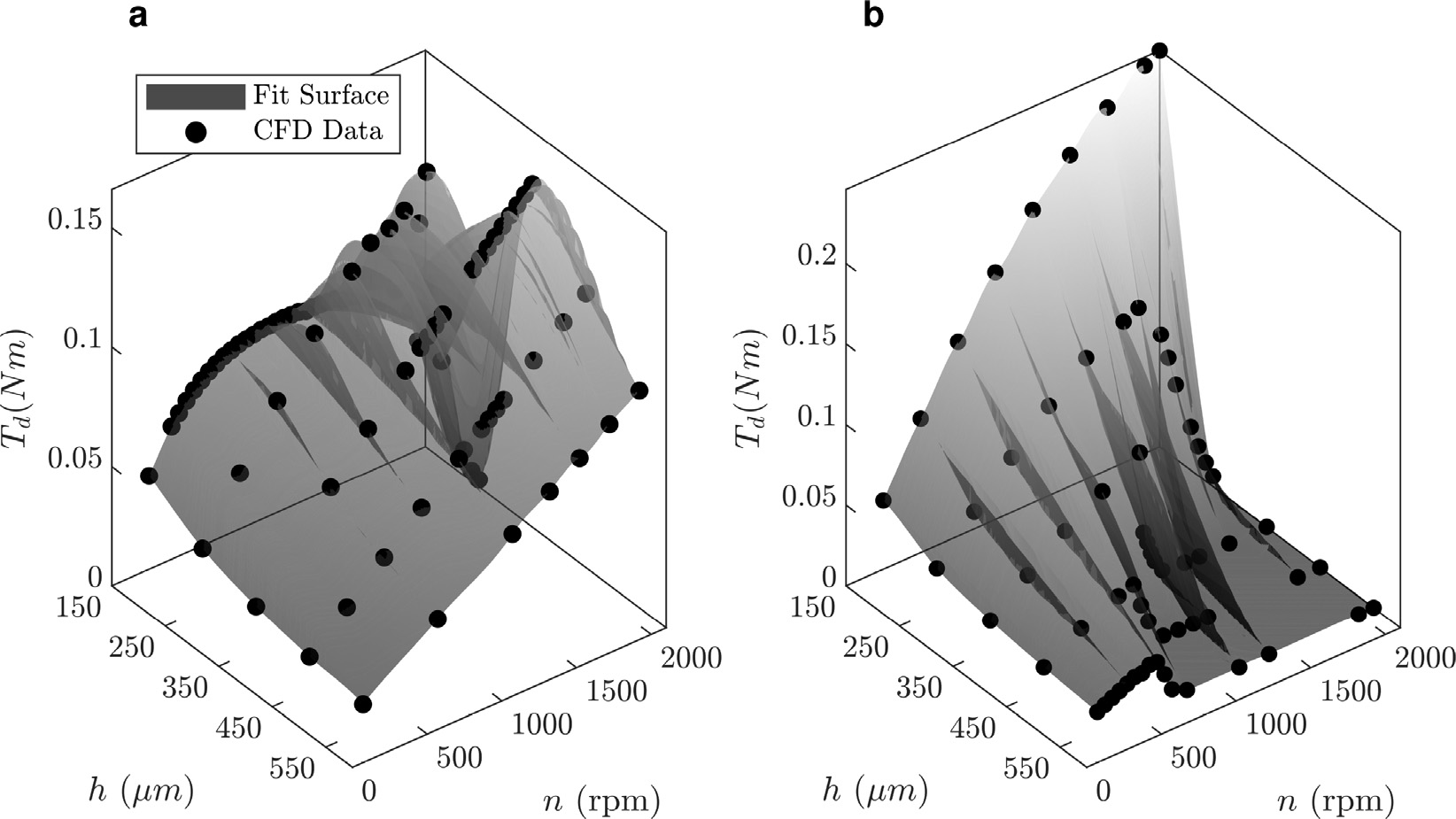
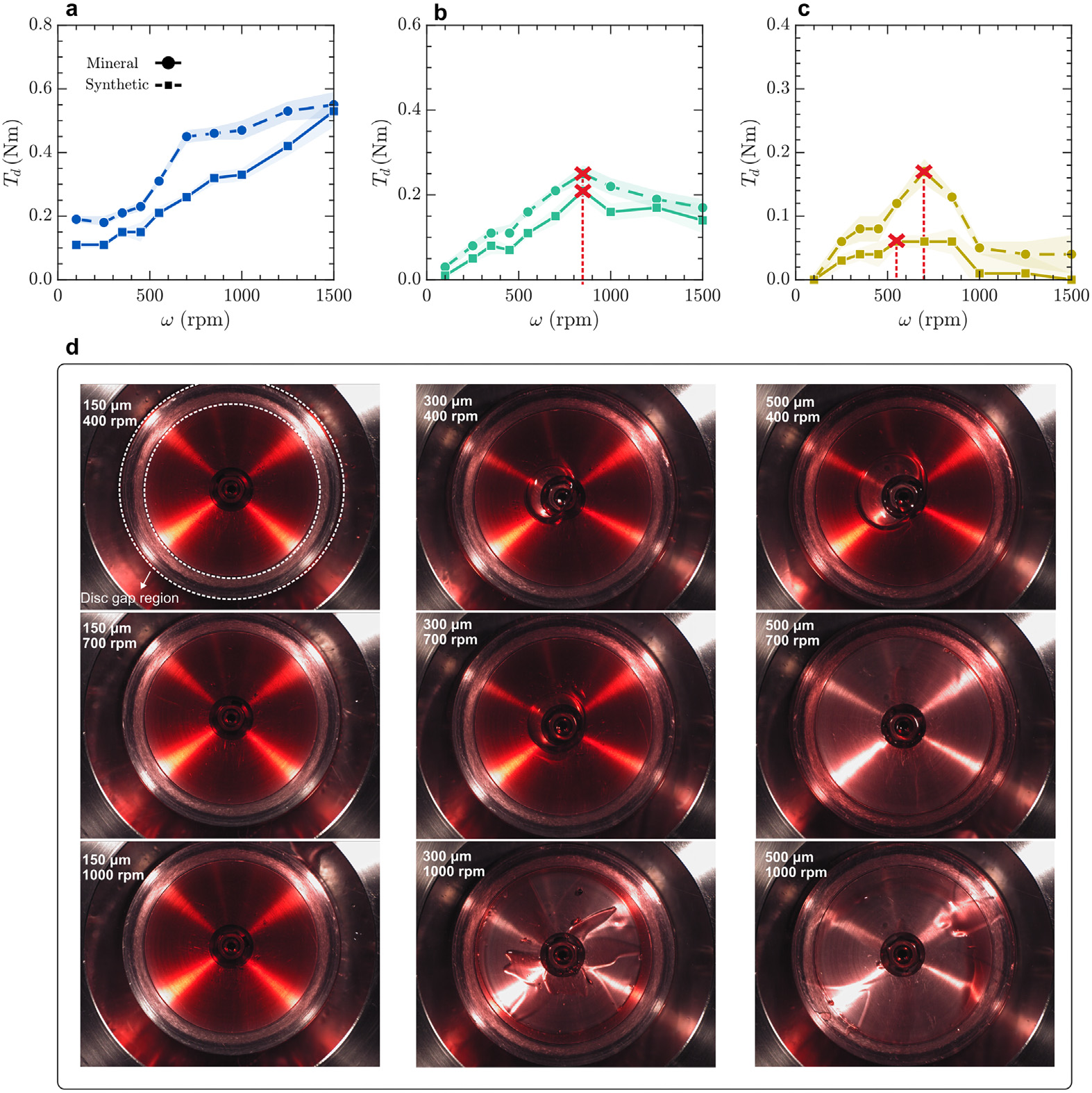
In the disengaged state, wet clutches remain a source of drivetrain loss because lubricant trapped between rotating plates is sheared by relative motion. The generated drag torque depends on film thickness, speed, lubricant viscosity, fill volume, surface tension, aeration and groove geometry. MD-Lab studies this open-clutch regime using CFD, experiments and optimization so that energy losses can be reduced without sacrificing torque capacity during engagement.
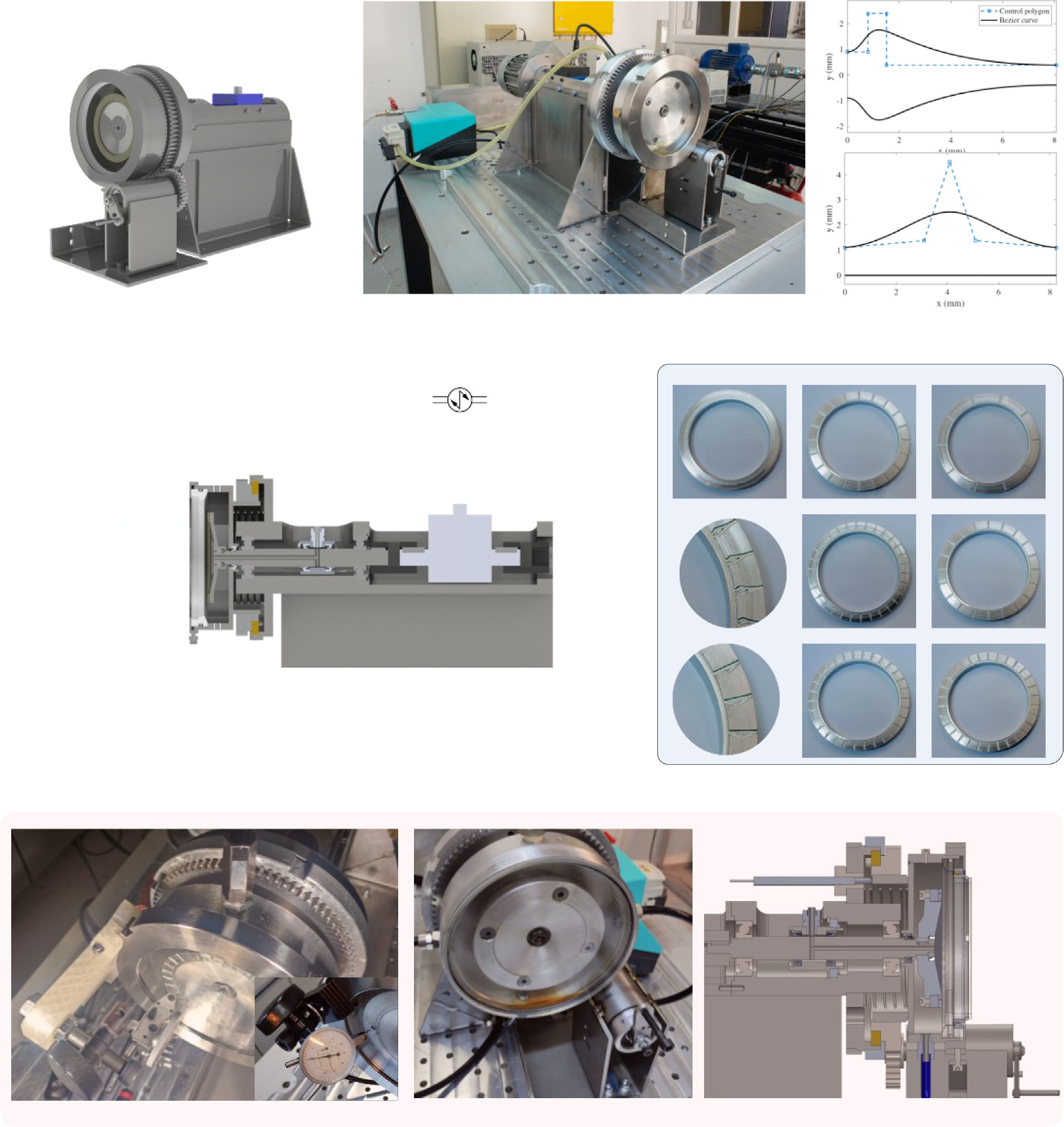
Early numerical work compared disk geometrical features and groove layouts using CFD-based drag-torque evaluation. Later studies expanded the design space by considering surface-tension effects, lubricant fill volume and experimentally validated groove topologies. The optimization workflow combines single-disc testing with Gaussian-process regression and multi-objective search to balance cumulative power loss against torque capacity.
- Up to 23% lower cumulative power loss for optimized arc-bow groove layouts
- Up to 21.8% lower cumulative power loss for mid-relief groove designs
- Coupled assessment of drag torque, friction torque and lubricant-fill effects
The resulting design space links flow visualization, drag-torque curves and manufacturable groove geometry. This helps turn wet-clutch surface design from a trial-and-error choice into a measurable energy-efficiency problem.
Related Publications
- Rogkas, N., Patsouras, D., Lazaridis, C., Zalimidis, P., Rakopoulos, D., & Spitas, V. (2026). Optimal groove design for viscous drag reduction in wet clutch lubrication to enhance energy-efficiency in power transmissions. Energy, 348, 140376. DOI
- Rogkas et al. (2026). Coupled effect of lubricant fill volume on drag and friction torque of dip-lubricated wet clutches. Journal of Tribology. DOI
- Rogkas, N., & Spitas, V. (2024). A study on the effect of surface tension on the drag torque of wet clutches. 24th International Colloquium Tribology. Link
- Rogkas, N., Almpani, D., Vasileiou, G., Tsolakis, E., Vakouftsis, C., Zalimidis, P., & Spitas, V. (2020). A comparative study on the effect of disks geometrical features on the drag torque of a wet friction clutch. MATEC Web of Conferences, 317, 04001. DOI
Engagement Dynamics and Squeeze-Swirling Flow
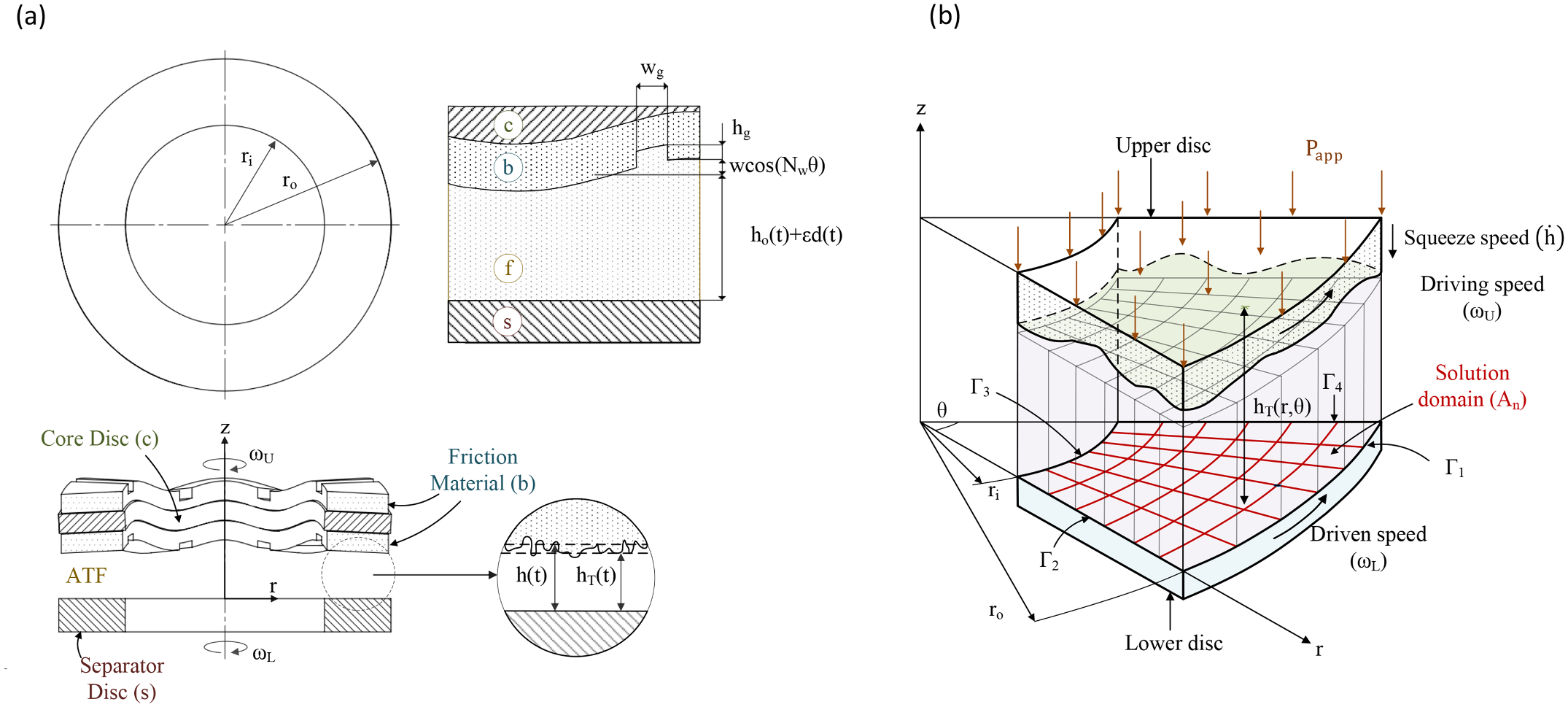
During engagement, the wet clutch transitions from a separated hydrodynamic film to torque transfer through a rapidly thinning lubricant layer and eventual surface contact. This phase is governed by squeeze flow, swirling motion, groove-induced redistribution of oil and the dynamic equilibrium of the moving disc stack.
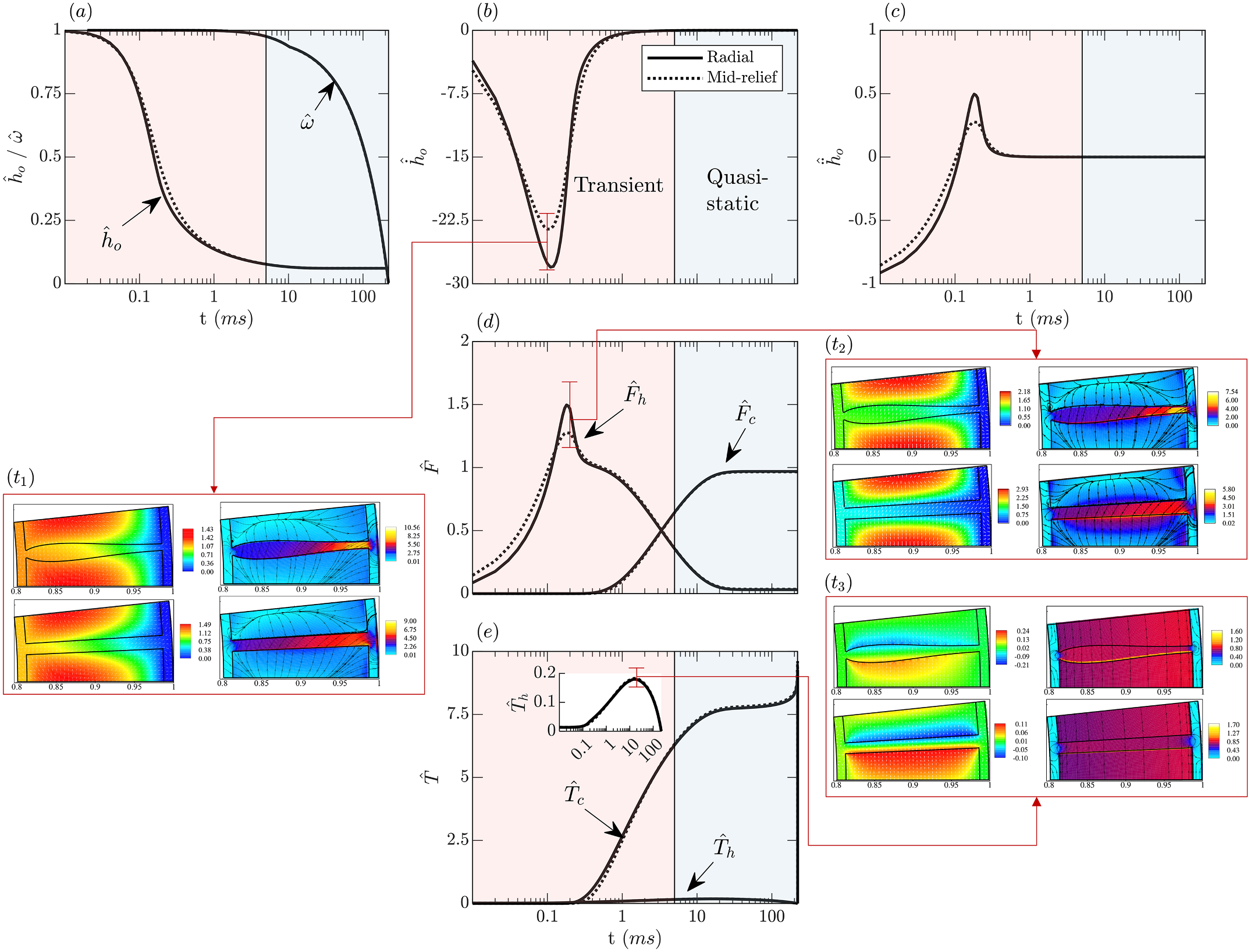
MD-Lab developed fast engagement models that couple fluid-film calculations with the mechanical motion of the discs. The hybrid transient/quasi-static approach solves the transient Reynolds-based response where it matters most and then switches to a lower-cost quasi-static representation, allowing design variants to be screened efficiently. The work shows that variable-width grooves can reduce hydrodynamic peak force while preserving a physically interpretable pressure and torque response.
- Transient hydrodynamic force and torque prediction during engagement
- Variable-width grooves reducing peak hydrodynamic force by roughly 20%
- Dynamic Navier-Stokes coupling for squeeze-swirling films between grooved discs
Recent work extends the engagement analysis to the filling phase, where squeeze-swirling films form before contact. By coupling the Navier-Stokes equations with dynamic force equilibrium, the research captures flow differences between grooved and non-grooved regions and provides guidance for more realistic wet-clutch filling models.
Related Publications
- Rogkas, N., Vasilopoulos, L., & Spitas, V. (2023). A hybrid transient/quasi-static model for wet clutch engagement. International Journal of Mechanical Sciences, 256, 108507. DOI
- Rogkas, N., & Spitas, V. (2025). Effect of dynamic parameters on squeeze-swirling flow between grooved discs. Proceedings of the Institution of Mechanical Engineers, Part C: Journal of Mechanical Engineering Science. DOI
- Rogkas, N., Vasileiou, G., Tsolakis, E., Spitas, V., & Zalimidis, P. (2019). Fast modelling and simulation of the dynamic behaviour of a wet multidisc clutch during the engagement phase. MATEC Web of Conferences, 287, 01018. DOI
Operational Envelope and Data-Driven Uncertainty
Wet clutch performance changes sharply across operating regimes. In some regions, simplified analytical expressions can describe the flow; in others, inertia, two-phase effects, clearance variability and non-uniform inflow dominate the response. MD-Lab uses nondimensional characterization and data-driven CFD workflows to map where different modelling assumptions remain useful.
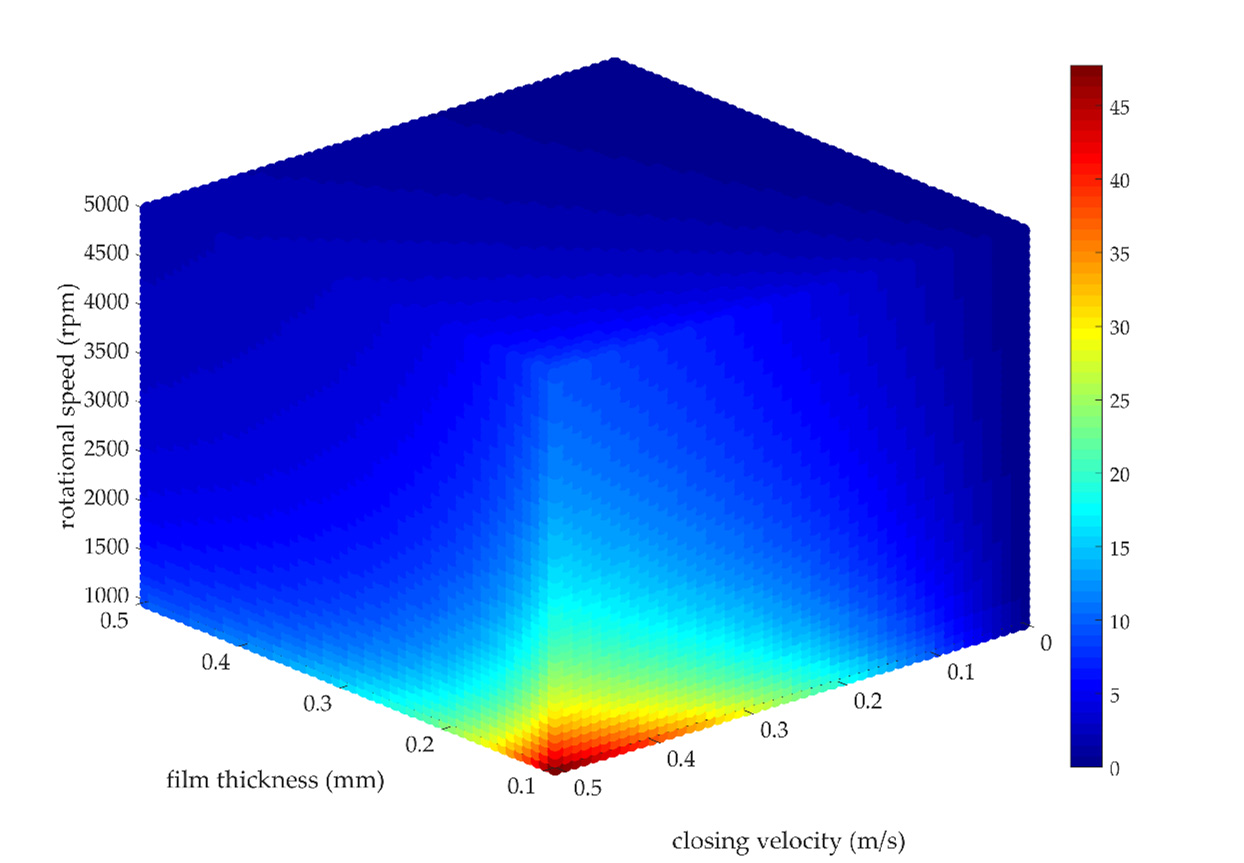
The nondimensional work applies Buckingham pi-theorem analysis to CFD post-processing, creating operating maps that show which Navier-Stokes terms are important across film thickness, rotational speed and closing velocity. This provides a principled way to decide when truncated analytical solutions are valid and when full CFD or hybrid modelling is needed.
- Nondimensional maps for the wet-clutch operating envelope
- Non-uniform disc-clearance effects on DCT wet-clutch drag torque
- Monte Carlo assessment of disc-gap and inflow-rate variability
More recent data-driven work combines a simplified two-phase CFD model with Monte Carlo analysis to quantify drag-torque uncertainty in multidisc wet clutches. By comparing uniform, normal, Weibull and beta disc-gap distributions under constant and variable inflow, the workflow shows how manufacturing and operating variability can materially affect efficiency predictions.
Related Publications
- Patsouras, D., Rogkas, N., & Spitas, V. (2025). Data-driven assessment of drag torque in multidisc wet clutches using a CFD-based Monte Carlo framework for disc gap and inflow variability. Tribology International, 212, 110964. DOI
- Rogkas, N., Vakouftsis, C., Vasileiou, G., Manopoulos, C., & Spitas, V. (2020). Nondimensional characterization of the operational envelope of a wet friction clutch. Computation, 8(1), 21. DOI
- Rogkas, N., & Spitas, V. (2020). Investigation of the effect of non-uniform discs clearance on the drag torque of a DCT wet friction clutch. ISMA2020. Link