Active Wave Journal Bearing
Monolithic Shape-Morphing Wave Bearing for Real-Time NVH Control
MD Lab research on active bearings investigates a hydraulically actuated monolithic journal bearing that can change its inner geometry during operation. The concept uses controlled pocket pressure to transform a nominally cylindrical bearing surface into a three-wave profile, enabling real-time adjustment of lubricant-film stiffness, damping and vibration transmission in rotating machinery.
Engineering Challenge
Plain journal bearings are compact, durable and effective for damping shaft motion, but they can become vulnerable to instability when the rotor operates near low-load or near-centered conditions. In many machines, noise and vibration are reduced with additional damping structures, which add mass, complexity and packaging constraints to the drivetrain or support system.
Wave journal bearings address part of this problem by replacing the circular inner bore with a small-amplitude wave profile. The non-circular lubricant film can increase stability, load capacity and vibration attenuation, especially in short bearings where oscillation damping is otherwise limited. A fixed wave geometry, however, is only optimal for a limited operating envelope. The research therefore focuses on a bearing whose geometry can be actively tuned so that the same component can respond to changing speed, load and NVH requirements.
Shape-Morphing Bearing Concept
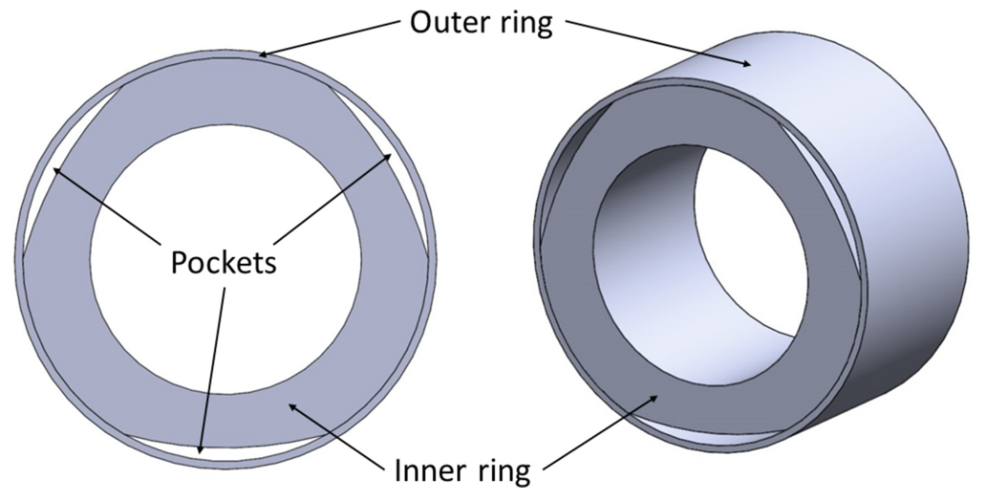
The proposed bearing consists of an inner ring and an outer ring. The outer surface of the inner ring is locally recessed so that, when the two rings are assembled, three hydraulic pockets are formed around the circumference. By applying pressure inside these pockets, the inner ring is elastically deformed and the bearing bore adopts a three-wave profile.
The concept takes advantage of the fact that useful wave amplitudes in hydrodynamic wave bearings are only on the order of micrometers. This makes it possible to create the required profile with practical hydraulic pressure levels rather than with a mechanically complex segmented system. Changing the pocket pressure changes the wave amplitude and therefore modifies the pressure distribution, stiffness and damping of the lubricant film.
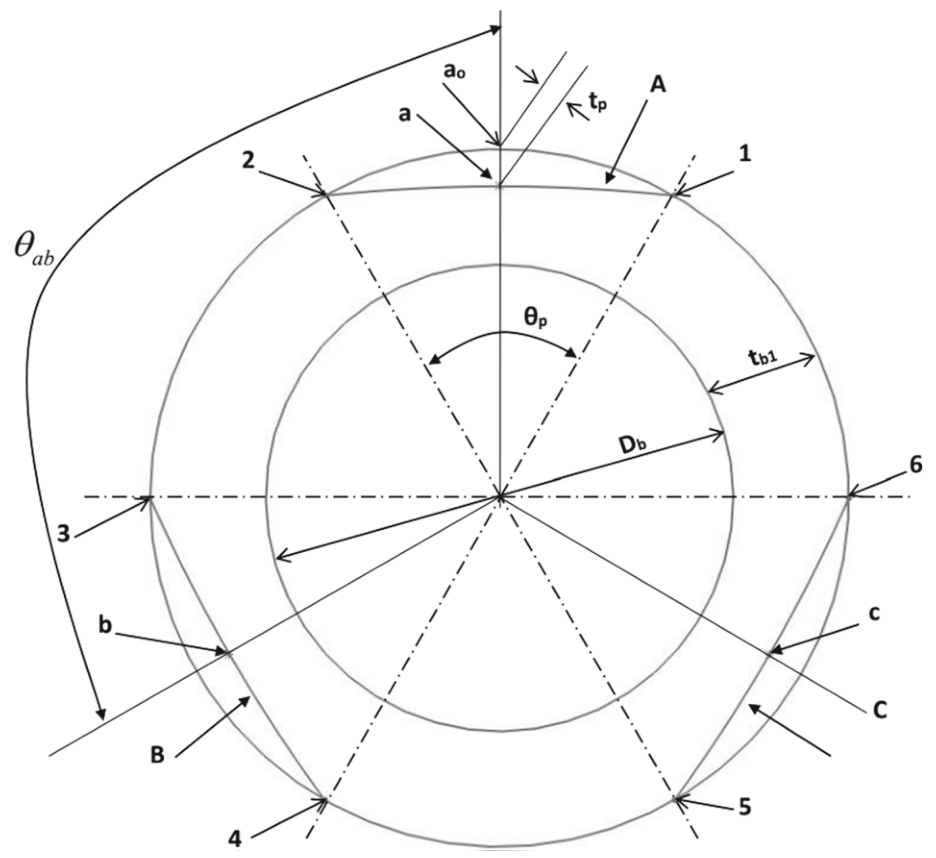
The design variables include the inner-ring thickness, pocket thickness, pocket angular extent, pocket position and target wave amplitude. These parameters must create the desired wave shape while preserving structural integrity, lubricant routing space and a sufficiently stiff outer ring.

CFD Modelling and Geometric Sensitivity
The numerical methodology combines computational fluid dynamics for the lubricant film with structural deformation analyses of the bearing rings. The CFD model in ANSYS Fluent used a circumferential discretization of 360 segments, three elements through the film thickness and a mesh of approximately three million elements. Benchmark comparisons against a published plain-journal-bearing case showed essentially matching pressure distributions, establishing the model as a reference for plain-versus-wave comparisons.
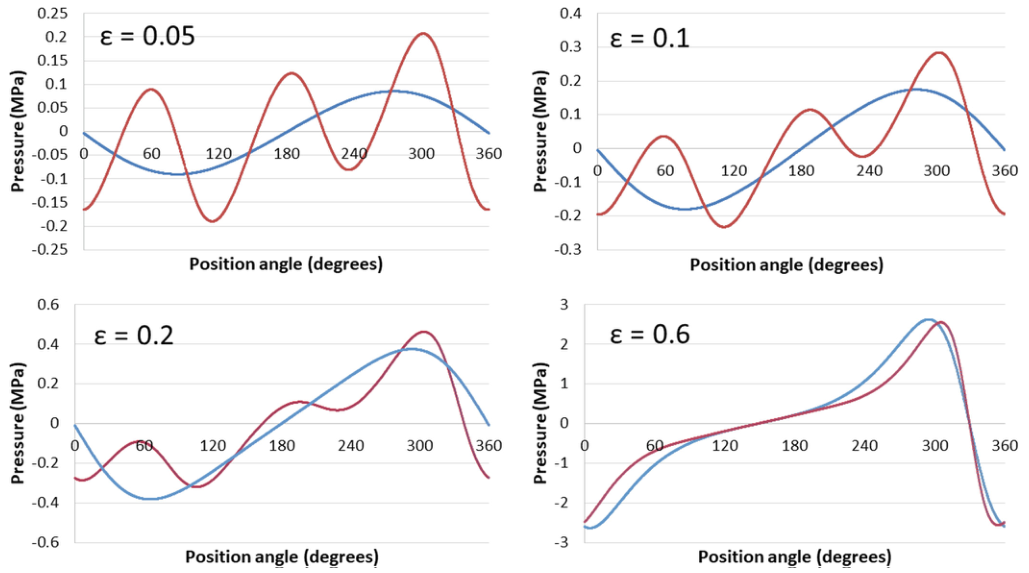
The simulations confirm why the wave geometry is attractive for active NVH control. At very low eccentricity, the plain bearing produces little useful hydrodynamic pressure, while the three-wave geometry generates three pressure maxima that support the rotor and improve stability. The wave effect is strongest at low eccentricity and becomes more pronounced as rotational speed increases.
A sensitivity study examined whether the shape-morphing bearing must reproduce a perfectly sinusoidal wave. Discrete lobe approximations with common minimum and maximum radii produced only small differences in global bearing response; the maximum local pressure differed from the continuous profile by about 8.9%, while the total force differed by approximately 0.15%. This supports the feasibility of a manufacturable pocket-actuated profile, provided the critical extrema of the wave shape are controlled.
Pocket Design and FSI Assessment
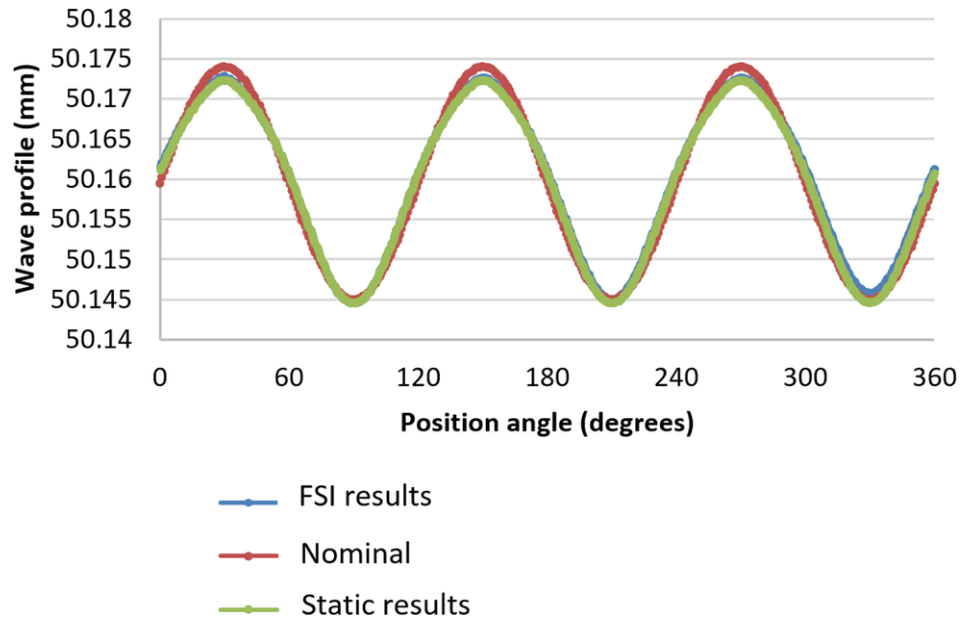
The pocket design stage used structural simulations to identify geometries that can reproduce the target three-wave bore while remaining robust to lubricant-film loading. The analysis considered the wave amplitude ratio, the pocket-to-ring thickness ratio and the pocket-angle ratio. A practical design constraint was that the deformation variation caused by operating pressure should remain within 10% so that the bearing continues to behave as a wave bearing over the expected eccentricity range.
The parametric results showed that thicker pockets relative to the inner ring increase deformation sensitivity, while the pocket angular extent controls how closely the generated profile follows the nominal wave. For the studied geometry, inner-ring thicknesses above 20 mm were generally more favorable, and pocket-angle ratios around 0.42 to 0.50 produced the closest match to the target profile.
The selected design was then evaluated with a fluid-structure interaction workflow using the actual pressure field imported from the CFD model. Compared with the uniform-pressure structural approximation, the FSI case required less pocket pressure and reduced the deformation variation from 9.4% to 3.8%. A local adjustment of the pressure in the most heavily loaded chamber further improved the profile match.
Dynamic Response and Main Findings
The dynamic study modelled a rotating arrangement with a motor, shaft, rolling bearing, shape-morphing wave bearing and off-center mass. The bearing was represented as a spring-damper element whose stiffness was obtained from the finite element results, while damping was evaluated from hydrodynamic bearing theory. This allowed the study to connect pocket pressure, bearing geometry and system-level vibration response.
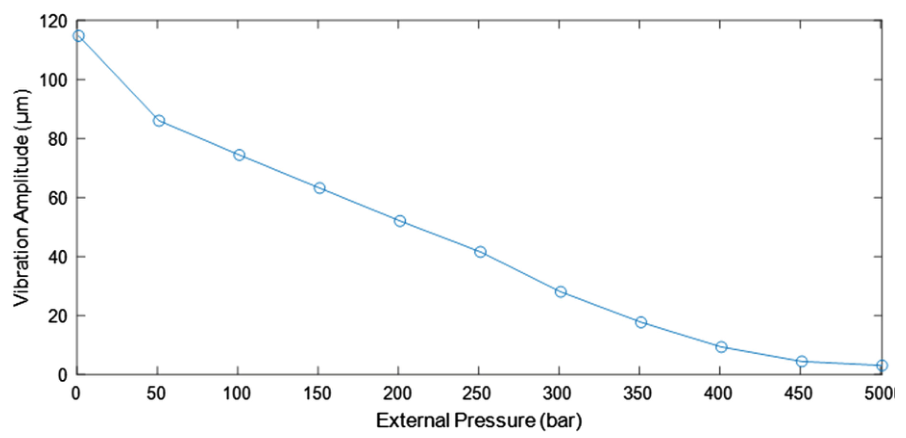
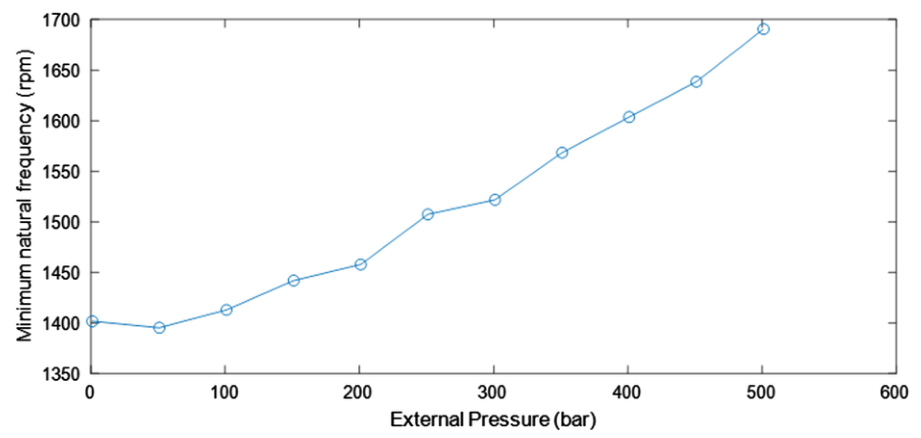
For the examined oscillation-reduction case, increasing pocket pressure strongly reduced shaft vibration amplitude; the reported reduction was approximately 94% across the investigated pressure range. A second case studied the ability to move the system toward anti-resonance by changing bearing stiffness. The minimum natural frequency increased with pocket pressure, indicating that the bearing can be used not only as a damper but also as an active tuning element for low-stiffness rotor systems.
Engineering Significance and MD Lab Contribution
The study demonstrates a route for embedding active NVH control directly into a hydrodynamic bearing. Instead of adding an external vibration absorber or replacing the bearing with a highly segmented mechanism, the proposed concept uses a monolithic pocketed ring that can morph between plain-like and wave-like operation. This makes the approach relevant to rotating machinery where vibration, sound radiation, mass and package space must be managed together.
The publication identifies the work with the Laboratory of Machine Design at NTUA. MD Lab researchers contributed the shape-morphing bearing concept, the pocketed monolithic architecture, the CFD and FSI modelling workflow, the parametric pocket design process and the dynamic simulations used to evaluate vibration reduction and anti-resonance behavior.