Upcycling Laboratory Equipment
Upcycling Obsolete Mechanical Equipment into Sustainable Laboratory Test Rigs
MD Lab research on design for upcycling investigates how retired mechanical equipment can be converted into high-value, polyfunctional laboratory test rigs. The work combines circular-economy principles with detailed mechanical design, finite element assessment, remanufacturing and modern instrumentation to reduce cost, material demand and development time without compromising experimental capability.
Engineering Challenge
University laboratories often own mechanically robust but technologically outdated equipment. Frames, actuators, transmission elements and precision bases may still have excellent stiffness, geometric accuracy and long-term dimensional stability, while the original controls, sensors or test functions no longer satisfy current research needs.
The engineering problem is therefore not simple disposal or repair. The challenge is to identify which parts of obsolete machinery still carry design value, preserve that value, and integrate it with modern drives, data acquisition, sensors and modular subassemblies. For experimental rigs, this is especially demanding because the final machine must remain accurate, stable, safe under load and adaptable to several test protocols.
Upcycling Methodology for Test-Rig Development
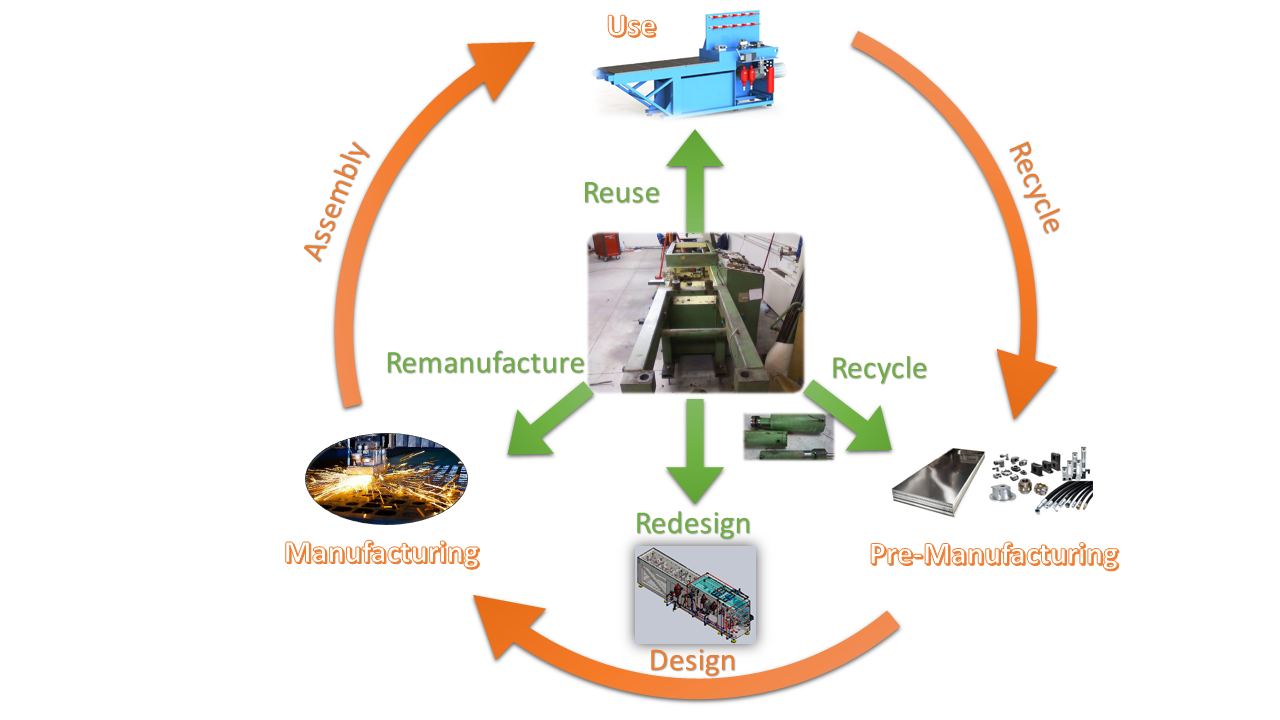
The proposed approach treats obsolete equipment as a stock of engineered resources. Mechanical parts and subassemblies are first assessed for potential reuse, redesign, remanufacturing or recycling. The assessment considers practical indicators such as component value, expected refurbished value, cost relative to new equipment, manufacturer support and reliability in future operation.
Reusable components are classified by function, such as structural frames, hydraulic units, electronics and transmission elements, and their specifications are stored with supporting documentation and CAD information. When a new laboratory rig is needed, the design team compares procurement with an in-house upcycling route. Approval depends on major cost reduction compared with market alternatives and a substantial reused portion of the final rig by weight or volume.
After this screening stage, the detailed design follows conventional engineering practice: requirements definition, CAD modelling, analytical checks, finite element analysis, workshop remanufacturing, assembly and instrumentation. The result is a purpose-built rig that keeps the useful mechanical performance of older equipment while adding contemporary experimental capability.
Case Study 1: Modular Hydraulic Test Bench
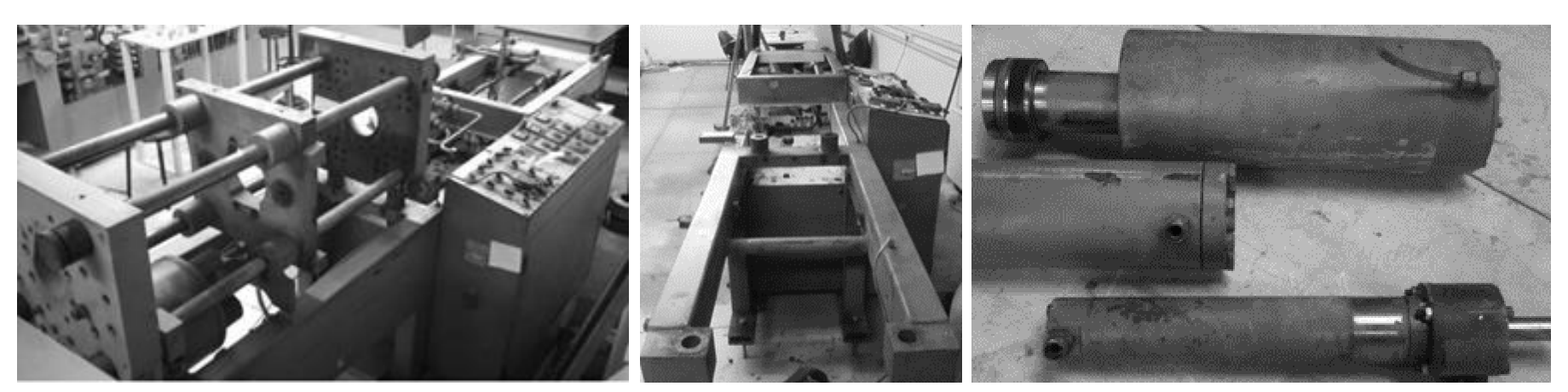
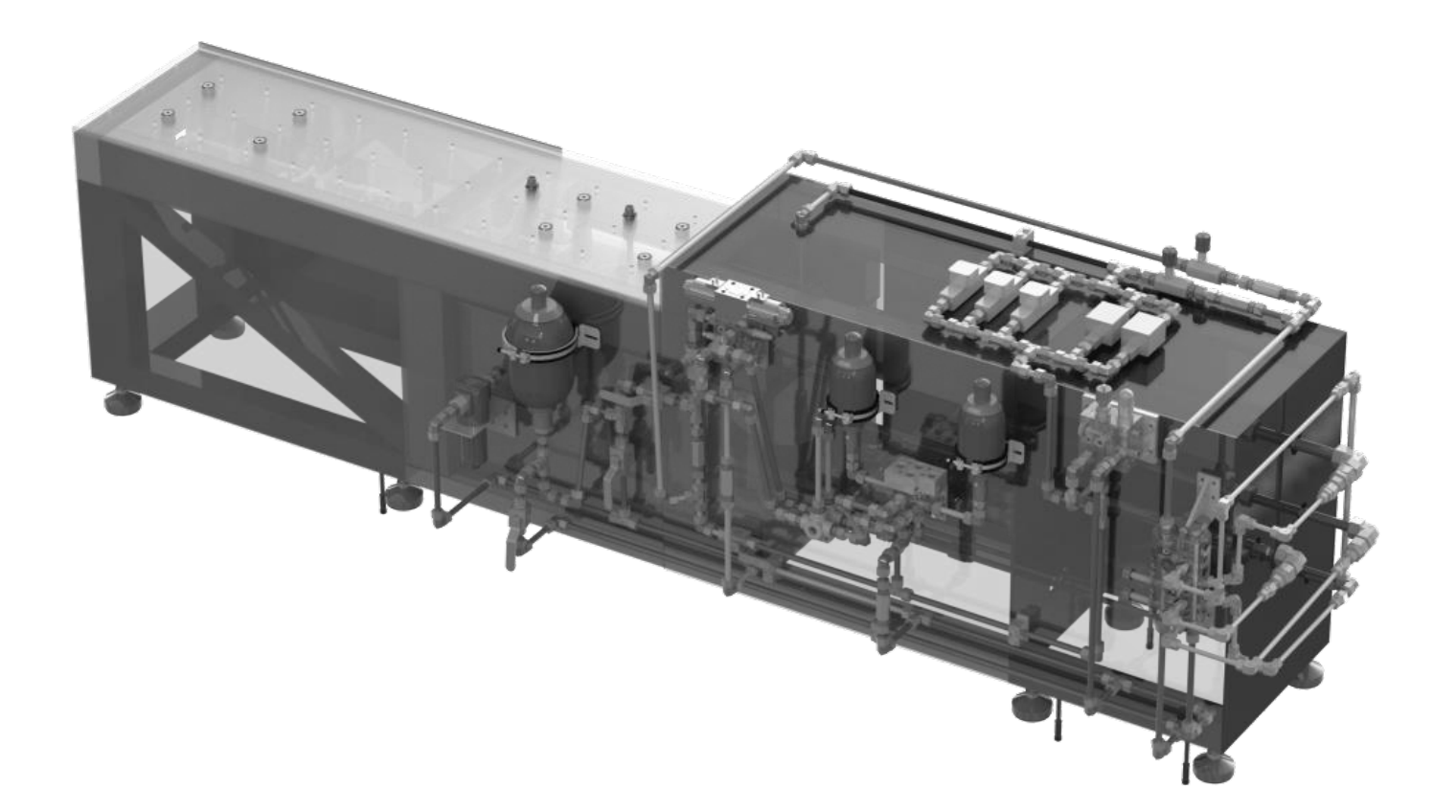
The first case study converted a nearly fifty-year-old FROMAG injection moulding machine into a modular bench for testing power hydraulic components. The target system needed to support several test types, including pump power-loss measurements, valve response assessment, burst-pressure testing and dynamic hydraulic-circuit characterization.
The original machine frame was attractive because of its heavy structure and mounting capacity, but the bench also had to withstand high operating loads while remaining modular. Finite element analysis showed that the recovered frame required additional stiffness for the expected dynamic excitation. Steel reinforcements were therefore designed and added, increasing the first eigenfrequency from about 41 Hz to about 101 Hz.
The upcycled bench reused more than 80% of the original steel frame and incorporated recovered hydraulic hardware, including high-pressure actuation components. The cost analysis reached an estimated 80% saving compared with an indicative market-equivalent solution, while 6R activities accounted for most of the final rig’s weight and volume.
Case Study 2: Hybrid Hydraulic/ICE Powertrain Rig
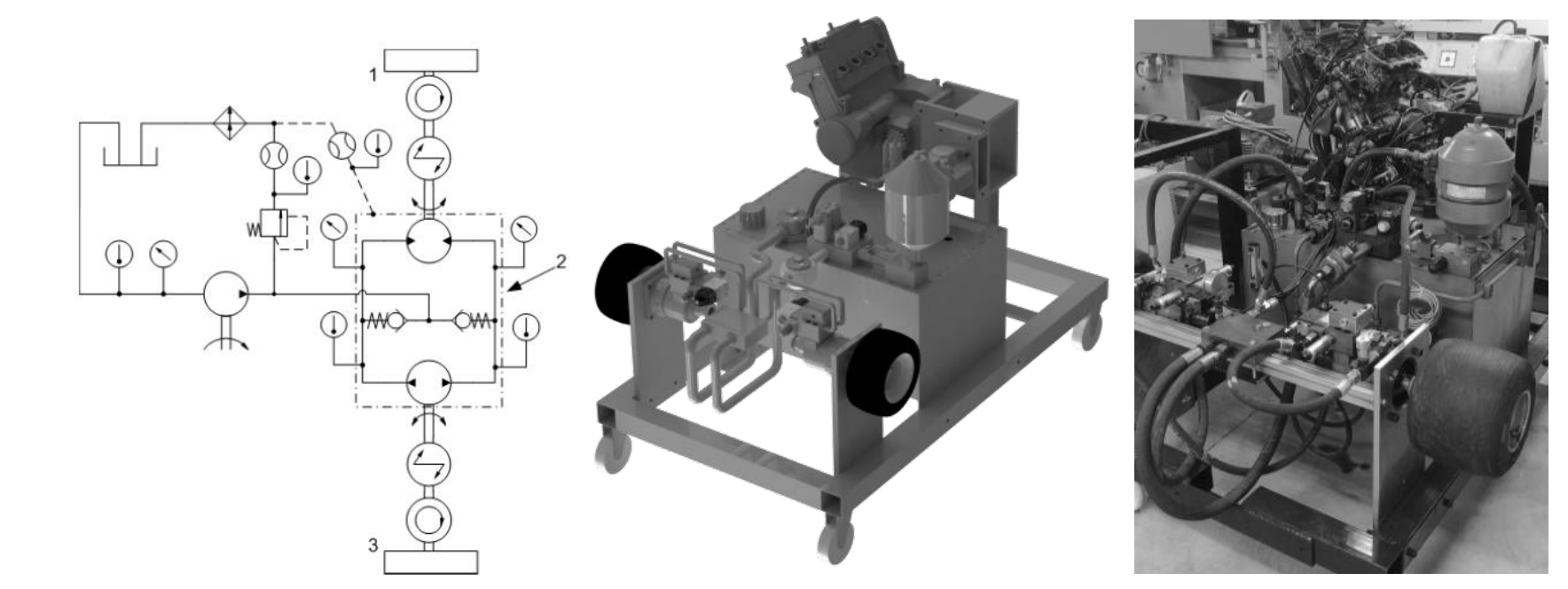
The second case study addressed the experimental investigation of hybrid hydraulic powertrains as an alternative to hybrid electric layouts. Such systems can use hydraulic pumps, motors, accumulators and wheel-side hydraulic drives to examine drivetrain architectures with high power-to-weight potential.
The rig was designed around a hydraulic circuit, a compact frame and a set of stock components recovered from dismantled laboratory machinery. Structural members were remanufactured from scrap and stored parts, while available hydraulic valves, accumulators, an internal combustion engine and supporting hardware were integrated into the final assembly.
The complete rig was produced from reused, recycled or remanufactured components by weight and volume. The estimated cost was approximately 10,000 Euro against a 38,000 Euro market-equivalent reference, corresponding to a saving of 73.7%.
Case Study 3: Augmented Gear Roll Tester
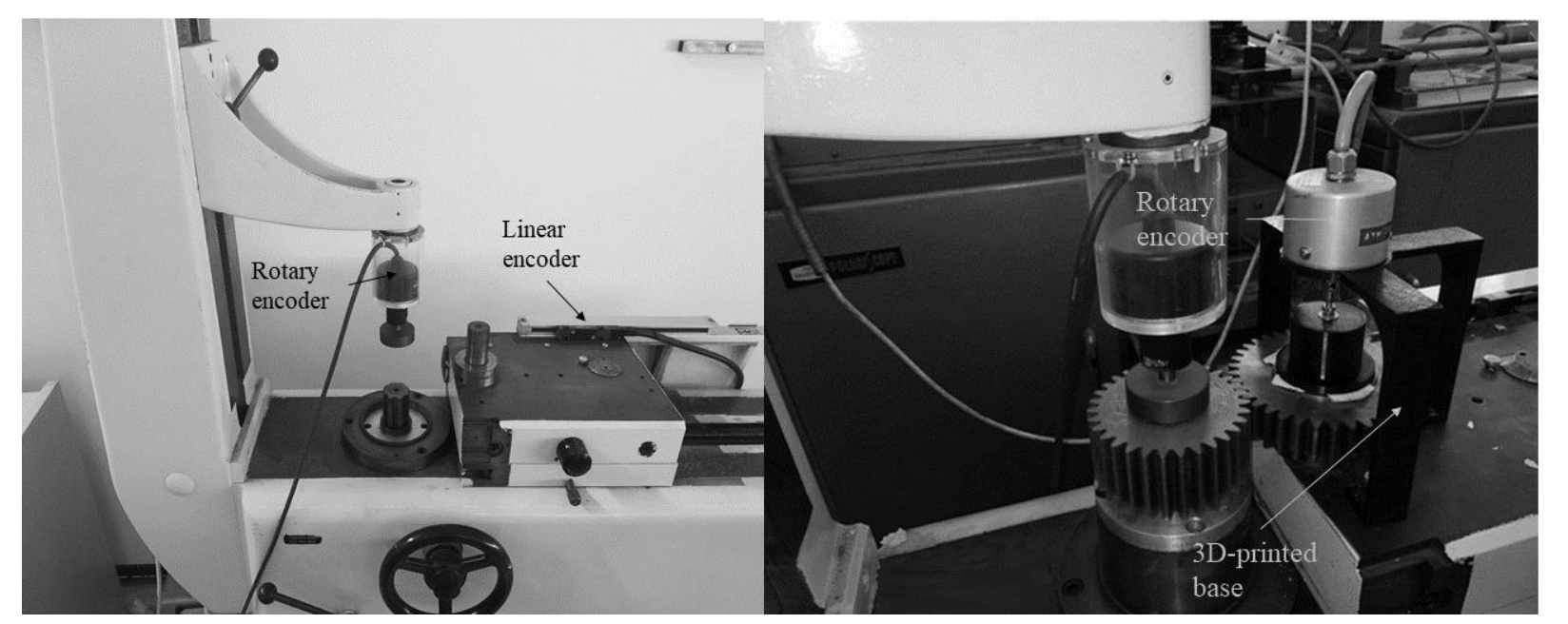
The third case study upgraded a Goulder Mikron double-flank gear roll tester that had been available at MD Lab since the early 1980s. The original machine frame remained suitable for precision use, but the measurement and actuation systems were obsolete and the machine did not provide single-flank testing capability.
The upcycling process preserved the core structure and replaced the manual and mechanical measurement elements with modern instrumentation. A custom motor-driven spindle was added for controlled angular velocity, the displacement measurement system was replaced by a high-accuracy linear encoder, and rotary encoders were installed to monitor the angular position of meshing gears in real time.
The upgraded tester can perform both double-flank and single-flank roll measurements, allowing a broader and more informative assessment of gear accuracy. The modernization reduced measurement uncertainty substantially, with the new linear encoder specified at 0.1 µm accuracy over a 4 mm gauge length, compared with an original measuring order of about 20 µm.
Main Findings and Engineering Significance
Across the three case studies, the reused, redesigned or remanufactured portion of each rig exceeded 90% by weight or volume. The cost analysis also showed substantial savings: approximately 80.0% for the hydraulic test bench, 73.7% for the hybrid hydraulic/ICE rig and 84.5% for the augmented gear tester.
The results show that upcycling can be more than a low-budget workaround. When supported by a rigorous design process, legacy mechanical equipment can become a resource for accurate, tailored and polyfunctional research infrastructure. The approach reduces raw-material demand, shortens the route to new experimental capability and makes advanced laboratory equipment more accessible in environments where purchasing specialized machines is costly or impractical.
Further methodological development can refine the indicators and thresholds used to decide whether a retired component should be stored, remanufactured, recycled or discarded, and can include cost, availability, functionality and repository constraints in a more formal objective function.