Cryogenic Testing of Concrete Thermal Expansion
Cryogenic Measurement of Concrete Thermal Expansion Coefficient
The Cryogenic Concrete Thermal Expansion project develops and validates an experimental test system for measuring the linear coefficient of thermal expansion of cylindrical concrete specimens down to approximately -160 °C. MD-Lab translated cryogenic materials-testing requirements into an implemented measurement setup for liquefied-gas containment design, combining cryostat design, controlled nitrogen cooling, displacement measurement, thermal modelling, calibration and experimental evaluation.
Project Need
The coefficient of thermal expansion of concrete is a critical input for estimating thermal strain, restraint stress and crack risk in structures exposed to large temperature changes. In cryogenic applications, such as liquefied natural gas storage and transfer infrastructure, the relevant temperature range extends far below conventional cold-weather design conditions and can approach the boiling range of nitrogen or liquefied gas.
Concrete is a heterogeneous material, so its low-temperature deformation is not governed by a single constituent. Hardened cement paste, aggregates and pore water respond differently during cooling; when water in progressively smaller pores changes phase, local volume changes and microstructural restraint can alter the measured thermal strain. The project therefore focused not only on measuring contraction, but also on building a test environment that maintains a known and uniform thermal state during the measurement.
Cryogenic Test System
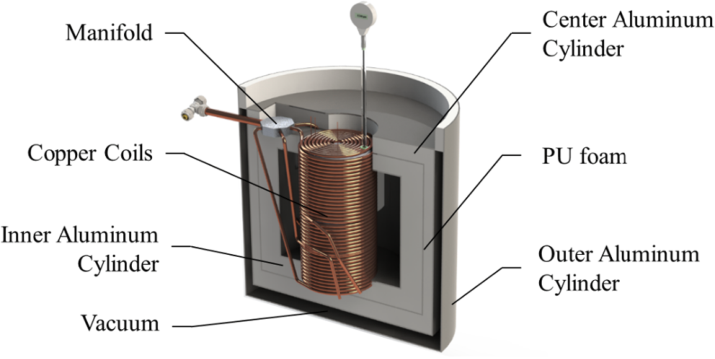
The experimental system was engineered around cylindrical concrete specimens with a diameter of 150 mm and a height of 300 mm. The specimen sits inside a Dewar-like chamber formed by concentric aluminium cylinders, vacuum insulation and polyurethane foam. Liquid nitrogen or cold nitrogen gas is distributed through copper coils placed around the specimen, with a copper foil layer improving thermal contact at the surface.
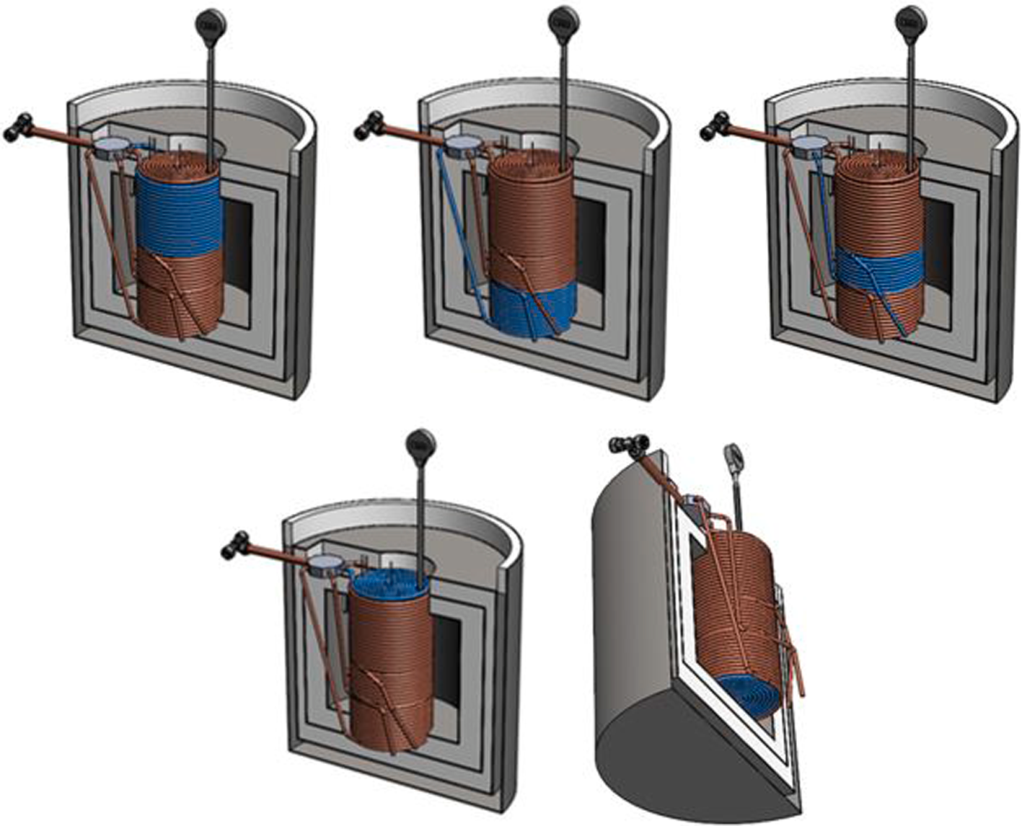
A central design decision was to use conduction-dominated cooling rather than relying on free convection inside the chamber. Separate coil circuits cool the top, bottom and side regions of the cylinder, while embedded thermocouples track the temperature field inside the concrete. Axial contraction is measured directly with a high-accuracy height gauge connected through quartz elements, avoiding the practical difficulties of bonding strain gauges to a cold, rough concrete surface.
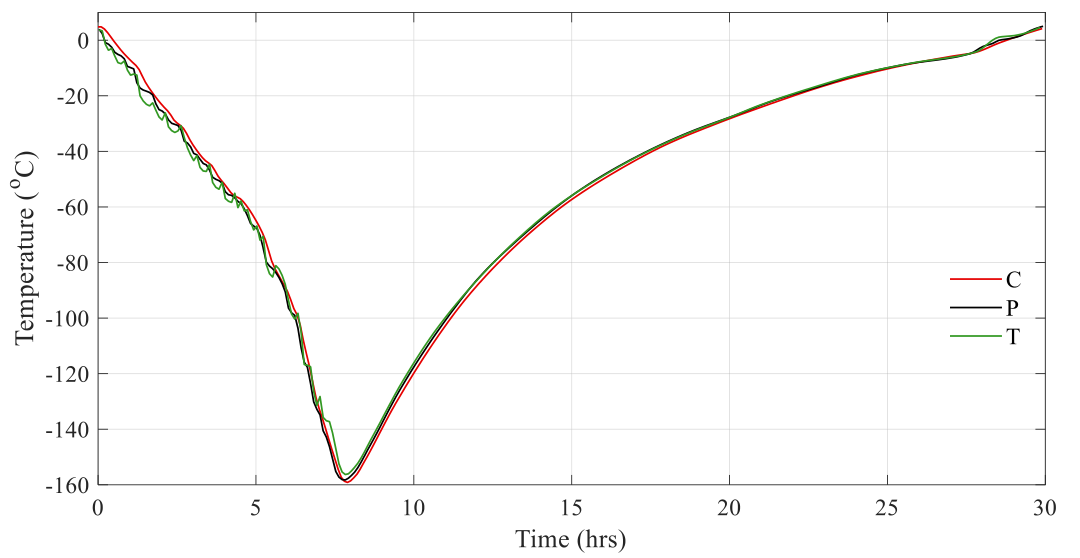
The system is controlled through a data-acquisition setup that monitors specimen and coil temperatures and regulates the nitrogen supply so that the internal temperature spread remains small during contraction measurements.
Thermal Modelling and Measurement Calibration
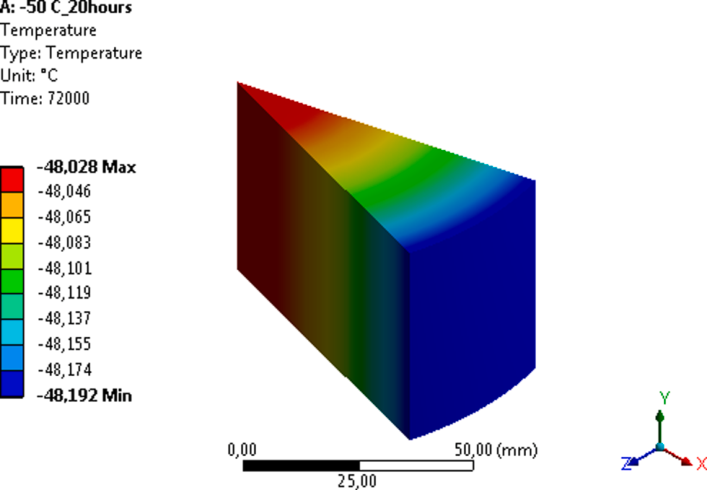
Finite element thermal analyses supported two important project design choices. First, a transient model compared the cooling behaviour of a concrete specimen under chamber free convection, showing that convection alone would require excessive time and would not provide the desired thermal control. This justified the conduction-based coil system used in the final cryostat.
Second, a steady-state model was used to quantify the contraction of the quartz tubes and rods in the height-gauge assembly. Because the measuring elements are themselves exposed to a temperature gradient, their thermal contraction introduces a systematic displacement component. The numerical model provided a correction function so that the recorded height-gauge readings could be converted into specimen contraction with improved metrological consistency.
Experimental Programme and Main Findings
The experimental campaign tested three concrete specimens with water-to-cement ratios of 0.38, 0.39 and 0.41 through controlled cooling from 0 °C to approximately -160 °C and subsequent heating back toward 0 °C. The specimens were cured under standard moist conditions for 28 days and then exposed to laboratory environmental conditions for six months before testing, so the measured response represents mature, relatively dry concrete.
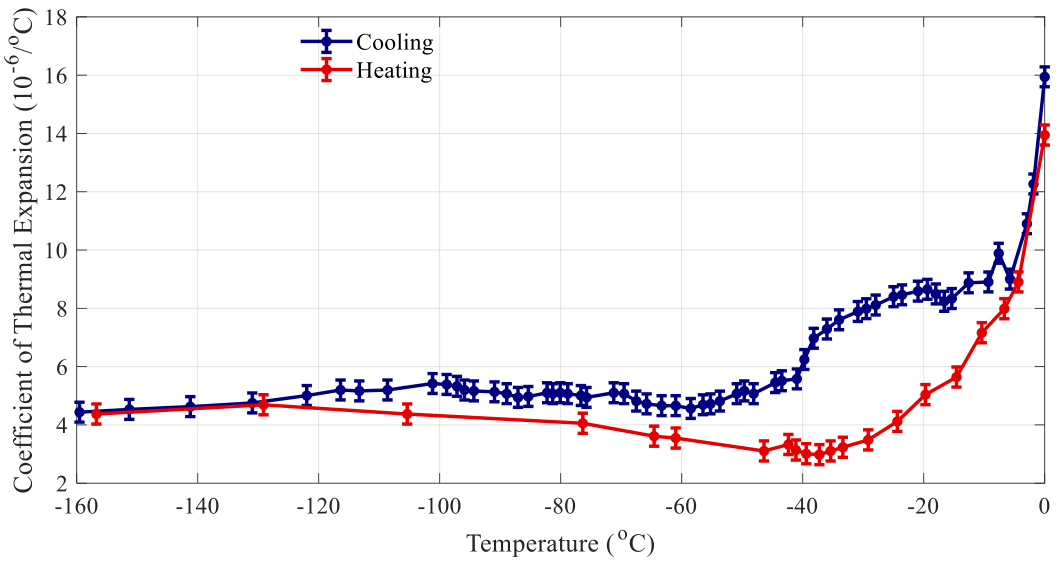
The measured thermal contraction coefficient was not constant across the cryogenic range. The reported average value decreased from approximately 20 x 10-6/°C near 0 °C to about 8 x 10⁻⁶/°C around -60 °C, and then to roughly 5 x 10⁻⁶/°C near -160 °C. The heating path generally followed the cooling trend at the lowest temperatures, with more pronounced deviation as the specimen returned toward the 0 to -70 °C region where freezing pore water has a strong influence on strain development.
For engineering use, the study distinguishes between integral and differential descriptions of the coefficient. The integral coefficient is directly connected to equivalent thermal strain over a temperature interval, making it useful for estimating the thermal stresses that matter in containment design.
Engineering Outcomes and MD-Lab Contribution
The project provides an experimentally grounded method for obtaining low-temperature concrete thermal-strain data over a range relevant to cryogenic containment structures. Its practical value lies in combining controlled specimen cooling, internal temperature monitoring, direct displacement measurement and correction of the measuring chain into a repeatable laboratory procedure.
MD-Lab contributed to the cryostat concept, the measurement methodology, the control and data-acquisition approach, the supporting thermal simulations and the interpretation of the cryogenic contraction results. This integrated design-and-test workflow supports safer use of concrete in applications where thermal gradients, restraint and pore-water phase behaviour can dominate structural performance.