Fluid-Borne Noise Attenuation
Modulated Herschel-Quincke Tubes for Fluid-Borne Noise Attenuation
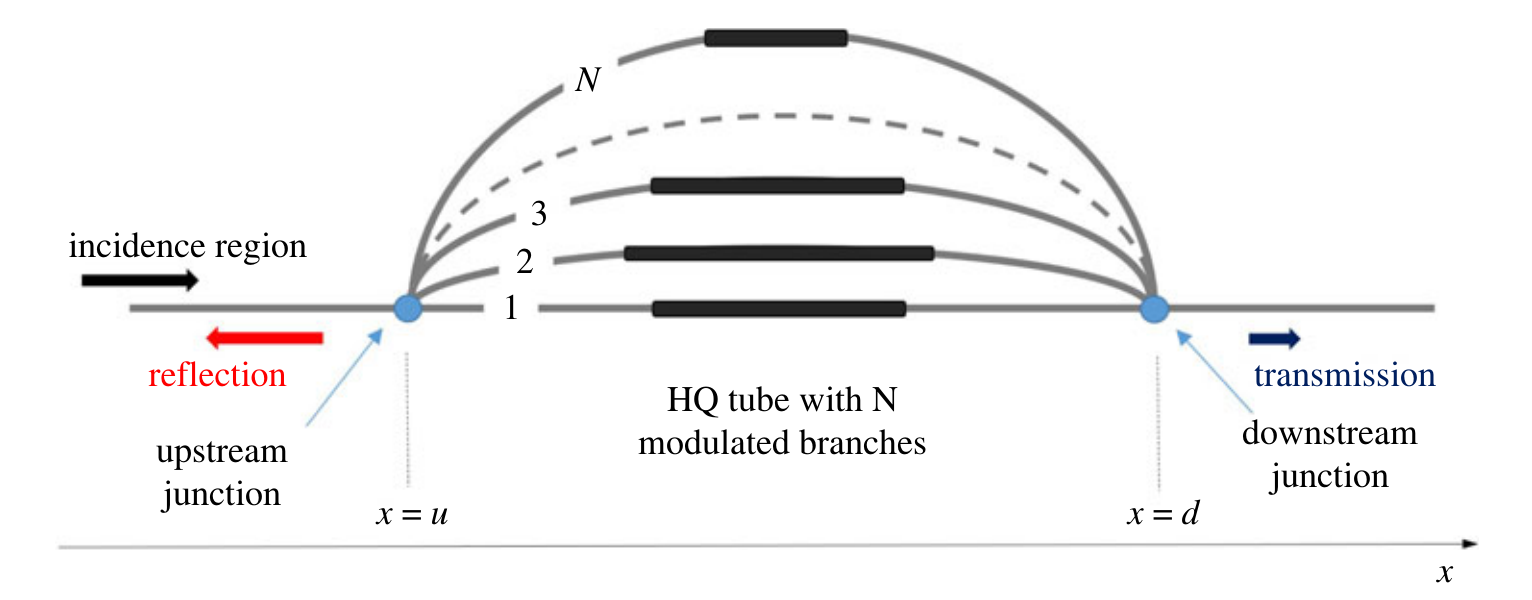
MD-Lab research on fluid-borne noise examines compact passive attenuation of pressure pulsations in hydraulic and pipe systems. The work extends the classical Herschel-Quincke interference silencer by introducing modulated branch properties, creating a tunable route to additional and broader transmission-loss bands without relying on impractically long side branches.
Engineering Need
Hydraulic pumps, valves and pipe networks generate pressure ripple that propagates as fluid-borne sound. Once transmitted through the circuit, these pulsations can excite structural vibration, increase radiated noise and contribute to fatigue in connected components. Conventional Herschel-Quincke tubes can suppress selected frequencies through destructive interference, but their attenuation bands are often narrow and their required branch lengths may be difficult to package in high-pressure hydraulic machinery.
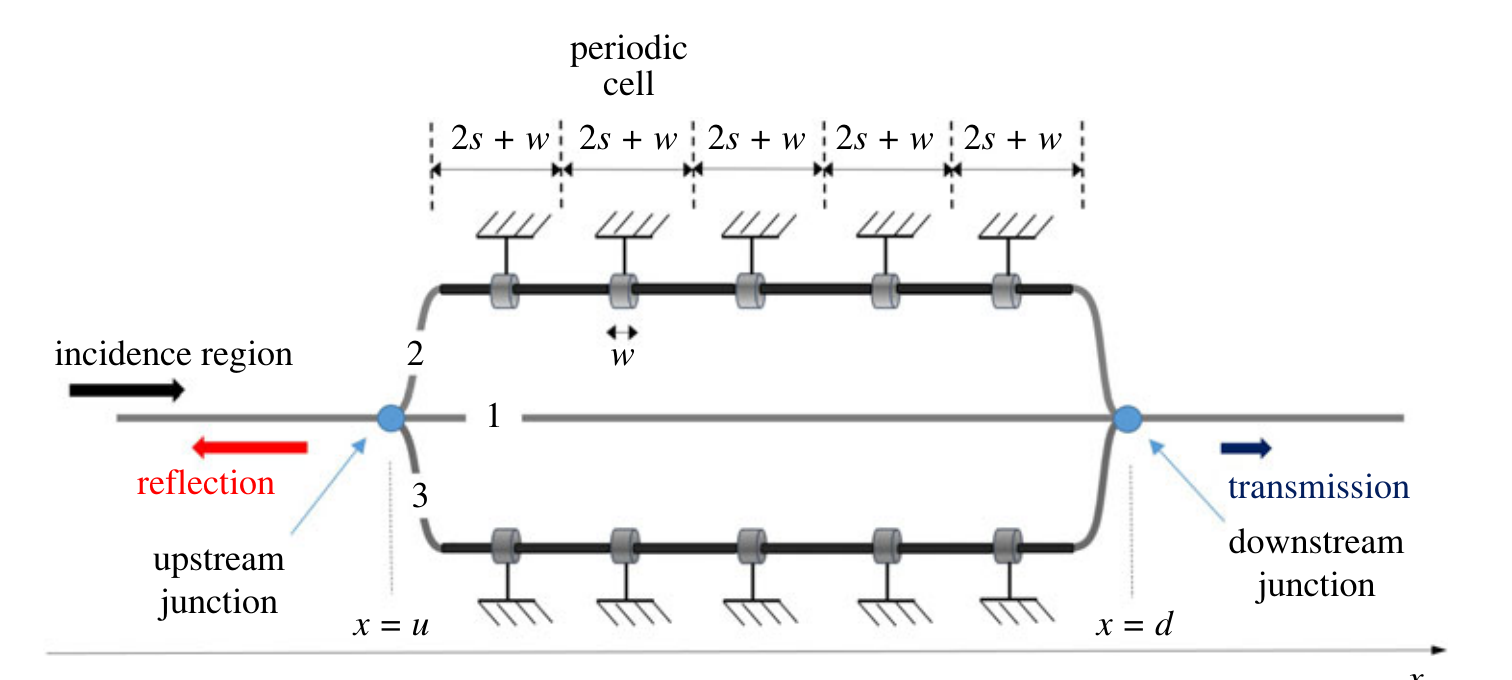
The modulated Herschel-Quincke concept addresses this limitation by treating branch wave speed as a design variable. Instead of extending a branch to shift its Helmholtz number, the branch can be spatially modulated through changes in local celerity, wall compliance or periodic stiffening. This creates a compact passive filter architecture for tuning pressure-ripple attenuation around the frequencies that matter most in a hydraulic circuit.
Modulated Branch Modelling
The analytical model is built on one-dimensional, long-wavelength pressure-wave propagation in a fluid-filled pipe. Under small-amplitude and low-Mach assumptions, the pressure and acoustic volume velocity are governed by linearized mass and momentum balance equations. The local wave speed is described through the Korteweg-Moens relation, making it dependent on fluid compressibility, pipe stiffness, wall thickness, diameter and end constraints.
When celerity varies along a branch, the governing equation becomes a Helmholtz-type problem with a spatially varying wavenumber. The work formulates transfer matrices for the uniform upstream and downstream branch regions and for the modulated segment. Junction conditions then assemble the complete tube response, allowing transmission loss and resonance frequencies to be predicted from closed-form or semi-analytical expressions.
The engineering value is speed and interpretability: the designer can identify attenuation bands and tune branch parameters before moving to detailed numerical models or prototype testing.
Transmission-Loss Tuning with Periodic Cells
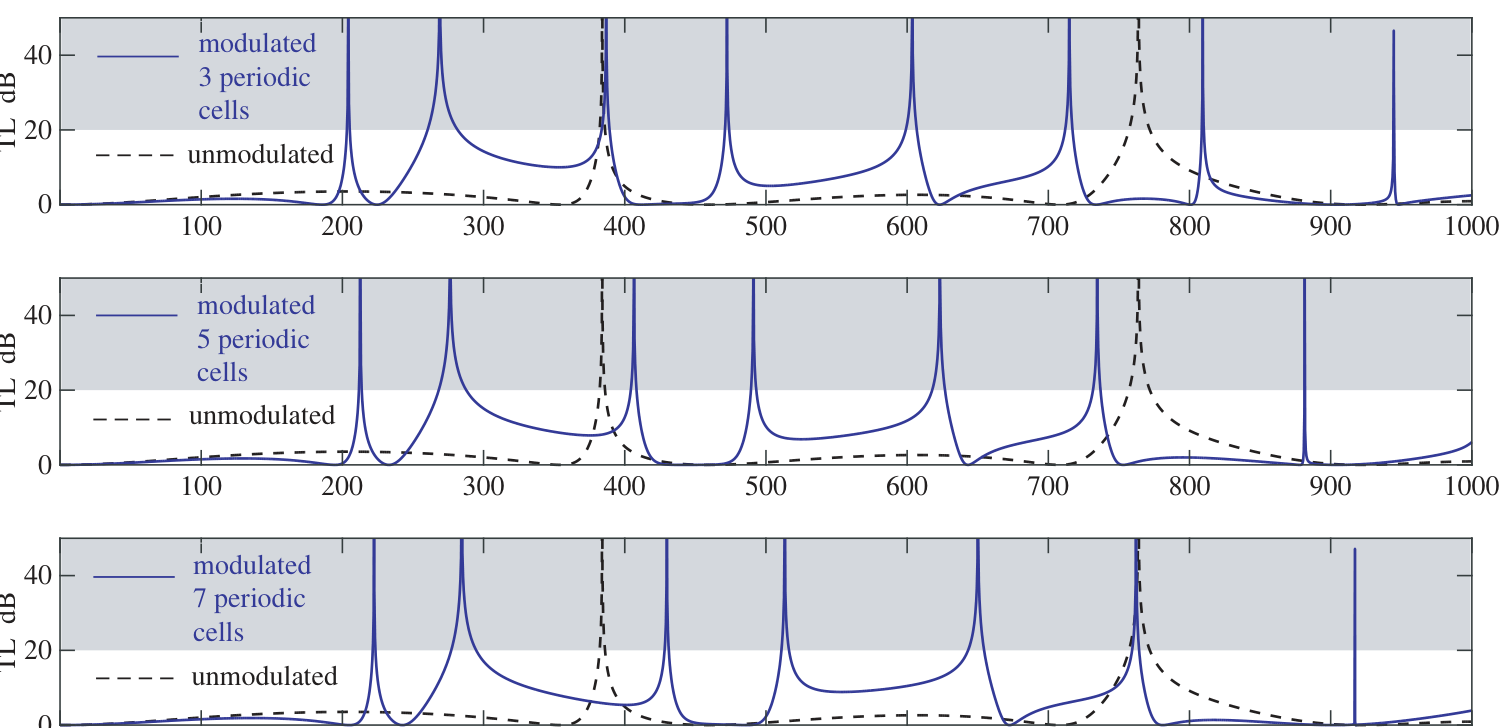
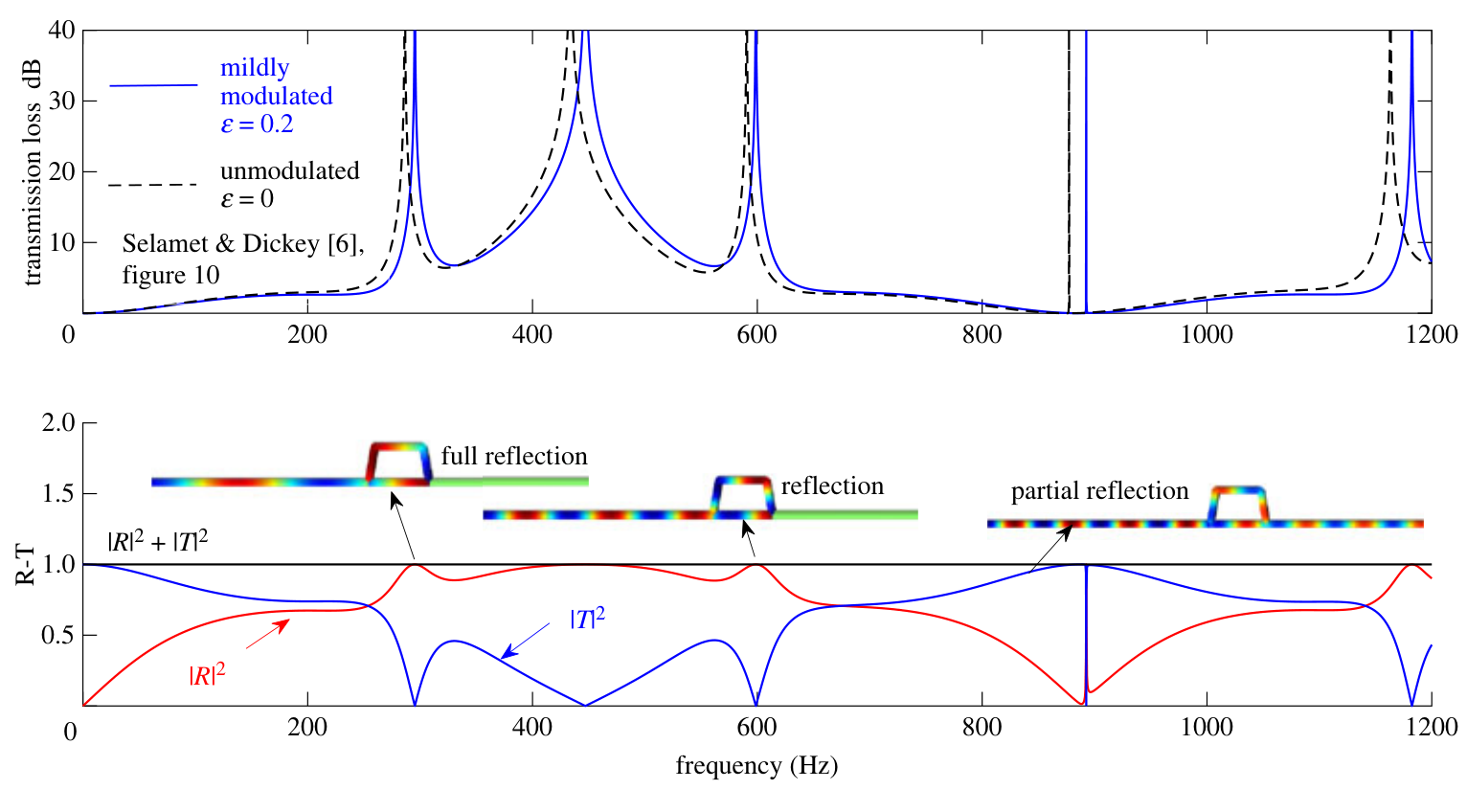
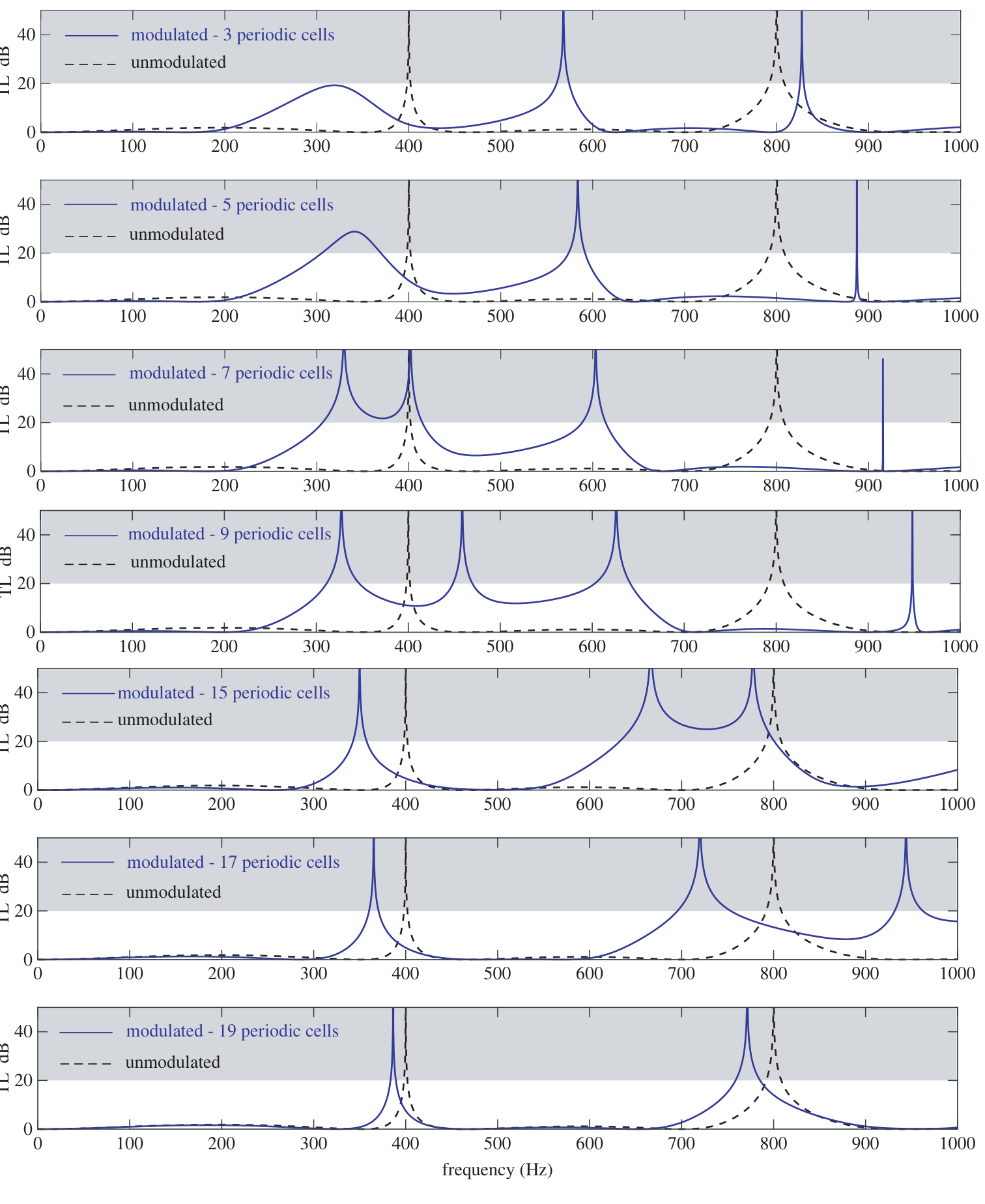
A key result is that periodic branch modulation can generate additional high-transmission-loss bands. In the studied configuration, a modulated side branch includes repeated cells formed by lower-celerity pipe segments and local stiffeners that raise celerity over short intervals. Varying the number of periodic cells changes both the number and placement of attenuation peaks.
For a single periodically modulated parallel branch, the analysis shows that low cell counts introduce a broad reflection region, while increasing the number of cells shifts the attenuation peaks and can split them into multiple bands. The shaded 20 dB region in the representative results marks the practically useful attenuation threshold. For engineering design, this means the attenuator can be shaped around discrete pressure-ripple components rather than treated as a fixed narrow-band silencer.
Multi-Branch Design for Hydraulic Circuits
The same formulation extends naturally to multiple parallel branches. Adding a second modulated branch increases the number of available attenuation peaks and can move the first useful band toward lower frequencies. When the two branches are intentionally detuned by assigning different celerity values, the response becomes richer: several distinct high-loss bands can be distributed across the operating spectrum.
This is especially relevant for hydraulic circuits driven by piston pumps, where pressure ripple often contains multiple harmonic components. A calibrated multi-branch MHQ tube can target several components simultaneously while remaining passive and compact. Future extensions identified by the work include mean-flow effects, axial tension and deformation modes, which are important for translating the concept into robust high-pressure hardware.